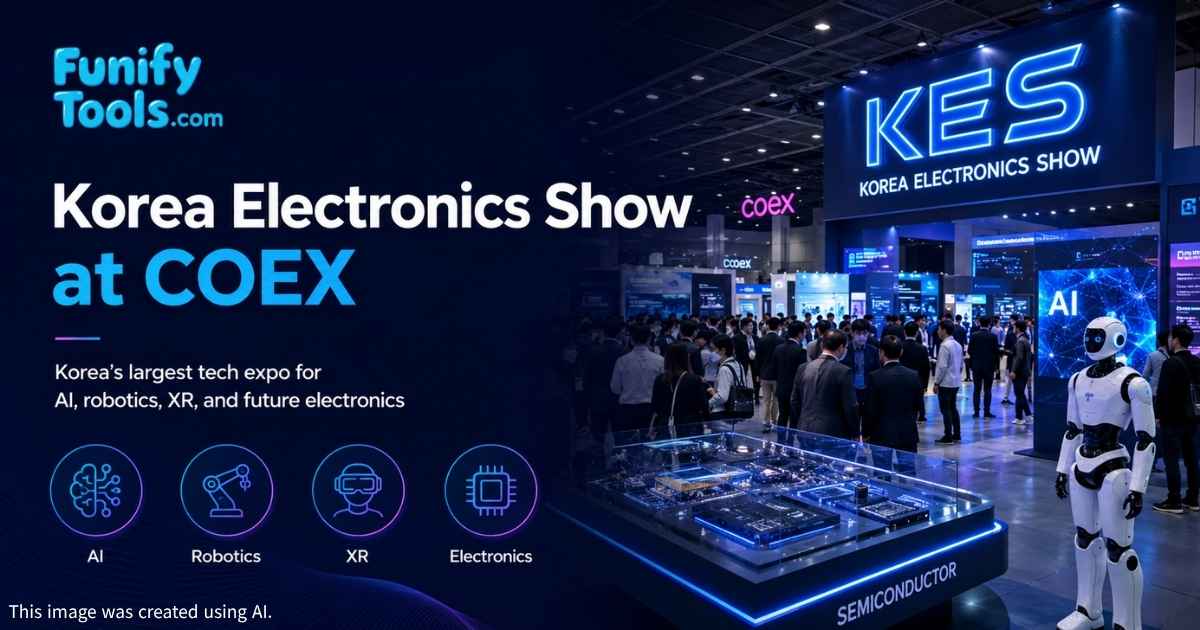
KES 2025 Preview - "Infinite Tech, Ignite Future" at COEX
The COEX Convention Center in Seoul hosted Korea's largest and most iconic technology festival, the 56th Korea Electronics Show (KES 2025). Since its launch in 1969, this historic exhibition has walked side by side with the evolution of the Korean electronics industry for more than half a century. The 2025 edition took place over four days from October 21 to 24, 2025, bringing together global technology leaders, manufacturers, startups, buyers, and visitors who wanted to see the latest breakthroughs firsthand.
KES is meaningful because it is not a small single-topic event. It is closer to a map of the electronics and IT industry. A visitor can move from consumer electronics to industrial parts, from AI services to robotics, from XR to healthcare, and from startup booths to large corporate showcases in the same venue. That variety is what makes the event useful for both professionals and curious general visitors.
The theme of KES 2025 was "Infinite Tech, Ignite Future", symbolizing the drive to go beyond technological boundaries and explore new possibilities. It reflects a vision of shaping a sustainable future through industrial convergence and global collaboration. This is not just a showcase of consumer electronics; it is a comprehensive technology expo featuring cutting-edge innovations across AI (Artificial Intelligence), semiconductors, robotics, XR (Extended Reality), Web 3.0, digital healthcare, and more.
The event occupied Halls A, B, and D2 of COEX, hosting around 550 companies across 1,300 booths, and was expected to attract over 70,000 visitors. Global tech giants such as Samsung Electronics and LG Electronics, along with promising startups and SMEs, participated, offering a rare opportunity to explore a wide range of new technologies and products in one place. Last year's event welcomed participants from 45 countries, and the 2025 edition was positioned as an even larger and more influential gathering.
The exhibition was open daily from 10:00 AM to 5:00 PM, with closing at 4:00 PM on the final day, October 24. On-site registration cost 20,000 KRW, while pre-registration provided free admission. Visitors also needed to remember that the last admission was 30 minutes before closing time, so arriving early was the better choice for anyone hoping to walk through multiple halls without rushing.
For an event of this size, preparation matters. It is easy to spend too much time at the first few booths and then realize later that another hall still remains. Checking the floor plan, choosing priority zones, and leaving time for unexpected discoveries can make the visit much more satisfying.
The Core of KES 2025: AI and Industry Convergence
At the heart of the event was AI Transformation (AX), the integration of artificial intelligence across industries. A special AI pavilion featured exhibits on Generative AI, On-Device AI, AI Semiconductors, Smart Homes, and Cybersecurity, showing how AI is moving beyond software demos into real products and business operations.
This direction is important because AI is no longer limited to chatbots or image generation. It is being built into chips, appliances, vehicles, factories, security systems, home devices, and business workflows. In other words, AI is becoming a layer inside many technologies rather than a separate category that stands alone.
Generative AI shows how machines can create text, images, code, and summaries. On-device AI shows how smart features can run directly on phones, PCs, appliances, or edge devices without sending every request to the cloud. AI semiconductors show the hardware race behind faster and more efficient computation. Cybersecurity shows the other side of the equation: as systems become smarter, they also need stronger protection.
For visitors, the AI pavilion was valuable because it connected big trends to concrete examples. Instead of hearing only that "AI is important," people could see how companies are applying it to actual devices, services, and industrial problems.
XR and Spatial Computing
In addition, the XR and Spatial Computing Pavilion explored the future of mixed reality, allowing visitors to experience technologies such as metaverse, digital twins, and spatial computing. This area showed how digital and physical environments are beginning to overlap more naturally.
XR is especially interesting because it changes the way people interact with information. A flat screen shows data in a frame, but spatial computing tries to place digital objects into the user's surrounding environment. That can matter in education, design, training, entertainment, manufacturing, architecture, and remote collaboration.
Digital twins are another important concept. They allow companies to create virtual versions of factories, buildings, machines, or cities, then simulate changes before applying them in the real world. When combined with sensors, AI, and cloud systems, digital twins can become powerful tools for planning and maintenance.
Expanding Beyond Electronics
KES 2025 also highlighted innovations in digital health, robotics, mobility, ESG (sustainability), Web 3.0/XR, electronic components, and smart manufacturing.
That expansion shows how the meaning of "electronics" has changed. In the past, many people associated electronics shows with televisions, home appliances, displays, and devices. Those areas still matter, but modern electronics now includes sensors, software, connectivity, AI models, robotics, chips, mobility platforms, and data services.
In the HealthTech Zone, visitors could explore emerging fields such as beauty tech, smart medical devices, and digital therapeutics. These technologies show how personal health, medical care, and lifestyle services are becoming more connected to data and smart devices.
Meanwhile, the Robotics Zone showcased live demonstrations of industrial, service, and logistics robots in action. Robotics is one of the easiest areas for visitors to understand visually because motion makes the technology feel real. When a robot moves, carries, sorts, serves, or responds, the future becomes less abstract.
Smart manufacturing was also an important theme. Factories increasingly depend on sensors, automation, AI analysis, machine vision, and connected production lines. For companies, these technologies can improve quality, reduce downtime, and make production more flexible.
A Hub for Global Networking and Business
Beyond product showcases, KES is also a major business networking platform. Throughout the event, attendees could take part in buyer meetings, investment sessions, keynote speeches, the KES Innovation Awards, and Welcome KES Networking Dinners. These programs were designed to foster collaboration, connect startups with investors, and create global business opportunities.
This business side is easy for casual visitors to overlook, but it is one of the reasons exhibitions matter. A booth is not only a display space. It can be a meeting point for suppliers, buyers, investors, developers, researchers, and media. A short conversation at an exhibition can sometimes become a partnership, a purchase order, or a future project.
The KES Innovation Awards recognized companies demonstrating outstanding innovation, offering benefits such as global media promotion and discounted participation fees. Awards like this help visitors notice products and companies that might otherwise be hidden among hundreds of booths.
Co-hosted by the Ministry of Trade, Industry and Energy (MOTIE) and the Korea Electronics Association (KEA), the event also provided practical benefits to exhibitors. Participating companies could receive export vouchers, international certification recognition, and support through KOTRA and other government programs for global expansion.
For startups and SMEs, these support programs can be as important as the exhibition itself. Building a good product is only one part of growth. Reaching overseas buyers, understanding certification requirements, meeting partners, and receiving policy support can decide whether a technology actually reaches the market.
How to Explore KES as a Visitor
If you are visiting an event like KES, it helps to think of the day in layers. First, look for major companies and headline booths to understand the big themes. Second, spend time in specialized zones such as AI, robotics, XR, healthtech, or smart manufacturing. Third, leave some time for smaller booths because startups often show surprisingly fresh ideas.
Students can use the event as a career map. By looking at booth names, job categories, technologies, and product explanations, it becomes easier to see what kinds of skills industries are looking for. Entrepreneurs can use the event to study market gaps. Professionals can compare vendors and trends. General visitors can simply enjoy seeing how quickly technology is changing.
It is also useful to take notes. At large exhibitions, many booths blur together after a while. Writing down company names, memorable products, and questions can help you remember what actually stood out. Taking photos of booth signs or brochures, where allowed, is another simple way to organize the visit later.
Experience the Future of Technology
This exhibition offered a rare opportunity to experience how advanced technologies are reshaping our world, from AI's impact on daily life, to robotics transforming industry, XR redefining spatial interaction, and ESG-driven sustainability shaping our shared future. KES 2025 brought all of these trends together under one roof, allowing visitors to witness the flow of modern technology in one immersive event.
If you are someone interested in electronics, IT, or emerging tech, KES 2025 was a must-watch event. It was more than just a visual exhibition. It was an interactive learning experience that helped visitors understand where the next wave of innovation is headed.
Whether you are a student, entrepreneur, industry professional, or simply curious about technology, events like KES can offer valuable insight and inspiration. They show not only individual products, but also the direction of entire industries.
Technology often feels abstract when we read about it in articles. But at an exhibition, it becomes physical: a robot moving across a booth, a chip displayed under glass, a headset demo, a smart healthcare device, a mobility platform, or a conversation with an engineer. That physical experience is what makes KES memorable.
Thank you for reading, and may your future be filled with innovation and happiness!
This article is also available in Korean: Read the Korean version