AI Festa 2025 - Field Notes from the Final Day
Even if you do not deeply understand AI technology, we now live in an era where almost everyone can use it in some form. In that sense, AI Festa 2025 was a must-see event because it did not simply talk about artificial intelligence as a future concept. It showed how AI is already moving into services, devices, public systems, healthcare, cloud infrastructure, and everyday experiences.
I attended on the final day around noon. Perhaps because of the timing, the venue was quieter than I expected. That actually made the visit more comfortable. Instead of being pushed along by a large crowd, I could slow down, look at booth displays carefully, and spend a little more time noticing the details.
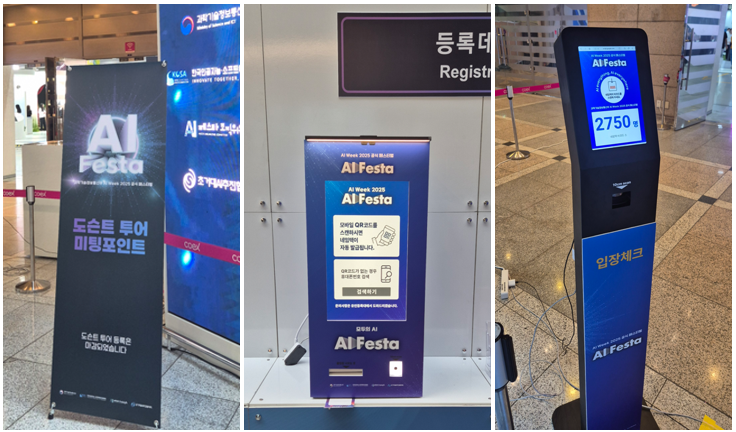
At the entrance, a large event banner greeted visitors, and several people were taking photos in groups. After scanning my pre-registered QR code at the reception, I received a printed ticket, which then needed to be scanned again at the gate. I wondered why direct mobile entry was not allowed, but there must have been a system behind it. In a way, even that small process matched the theme of the event: registration, identification, tracking, entry, and data all connected through a digital flow.
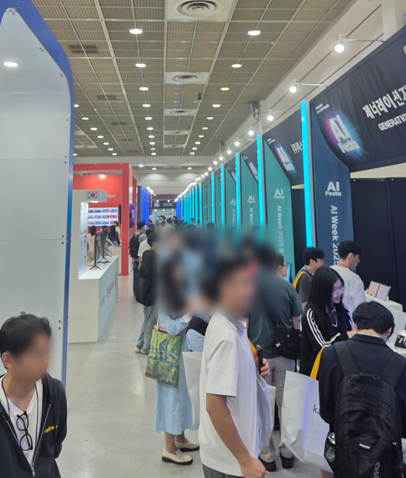
Walking into the hall, I had the feeling that this was not just a technology exhibition for experts. It was also a snapshot of how ordinary life may change. Some booths were clearly aimed at businesses, while others were easy for general visitors to understand. That mix made the event more interesting.
A Walk Through the Exhibition Halls
The moment I entered, I realized how vast the scope of AI had become. Each booth presented AI in its own way. Some used bright displays and polished demos, while others focused on quieter hands-on experiences. Instead of one single definition of AI, the hall showed many versions of it: AI as assistant, AI as infrastructure, AI as robot, AI as recommendation system, AI as security tool, and AI as public service.
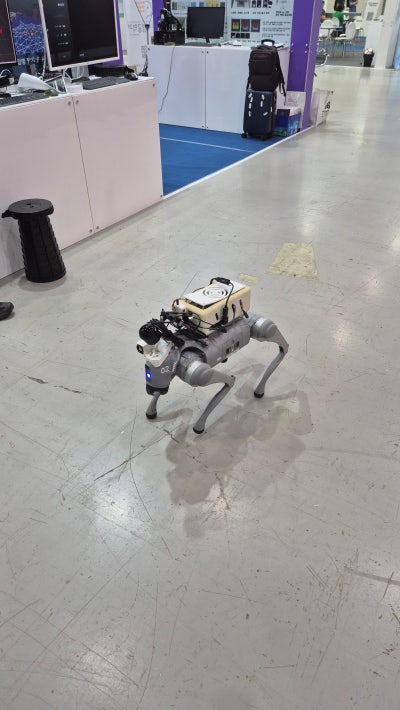
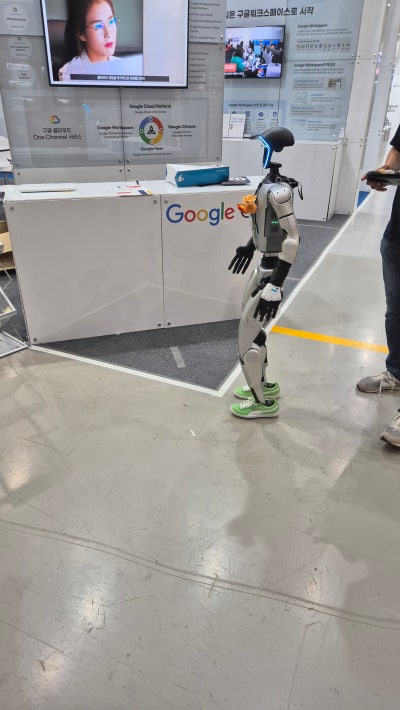
What drew the most attention were the robots. A humanoid robot walking and greeting people, and a playful dog-like robot circling around the area, both served as living performances. It felt as though AI had stepped out of screens and into the physical world.
The robots were interesting not only because they moved, but because people naturally gathered around them. Visitors took photos, waited for reactions, and watched how the robots responded to the environment. That reaction itself was meaningful. When AI appears as software, people often think of prompts and chat windows. When it appears as a moving machine, the emotional response changes immediately.
Beyond being an industry showcase, AI Festa 2025 was a space that inspired imagination about the future. Walking through the booths, I felt that AI is no longer confined to one field; it has become a universal language across industries. From news, fragrance, education, healthcare, defense, government, and culture, every domain seemed to be exploring how AI could reshape existing work.
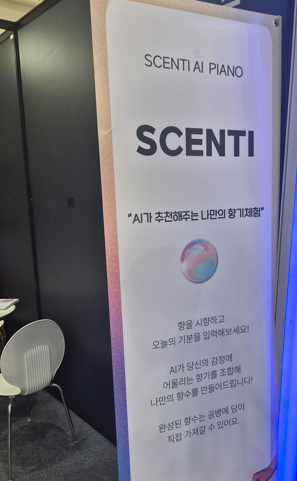
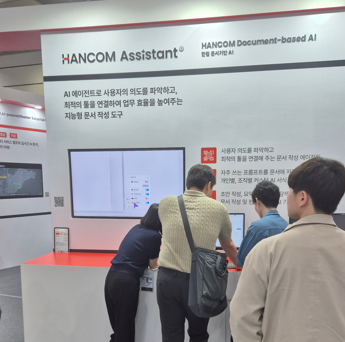
Some booths let visitors discover AI-powered fragrance recommendations, automated document generation, or facial recognition systems. These examples were easy to understand because they connected AI to familiar human actions: choosing a scent, preparing documents, identifying a face, or making a decision faster.
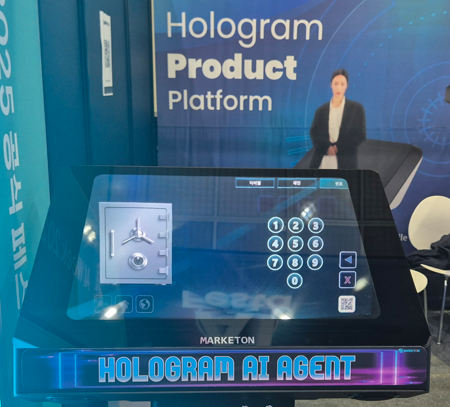
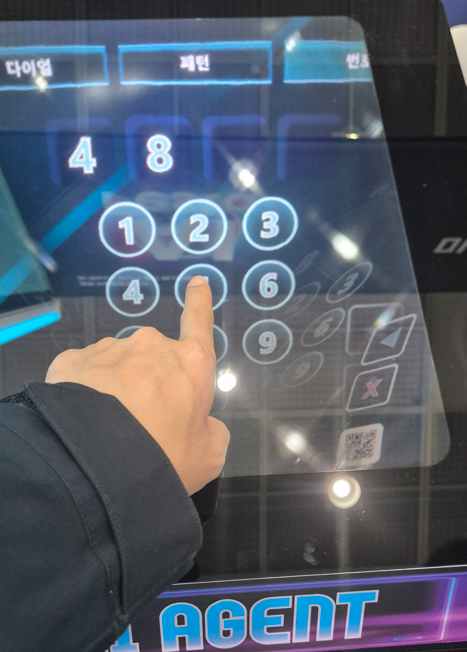
Among them, the most fascinating was MARKETON's holographic password system, where floating buttons in the air could be pressed without physical contact. It truly felt like a scene from a science fiction movie. What made it memorable was not only the technology itself, but the feeling that the interface had changed. Instead of touching a physical screen or keypad, the user interacted with empty space.
Cloud Services Behind AI
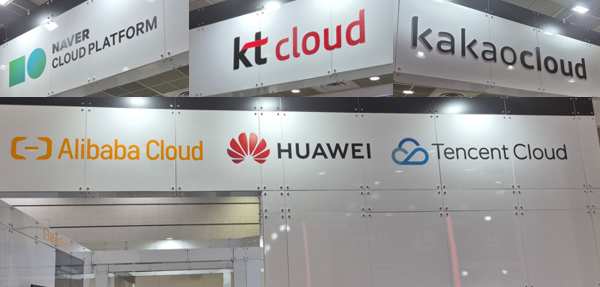
Another highlight was the wide range of cloud computing services, from Naver Cloud and Kakao Cloud to Google, Huawei, Tencent, Alibaba, and KT Cloud. Their presence made one thing very clear: AI is not only about clever models or impressive demos. It also depends on the infrastructure that stores data, processes requests, trains systems, and delivers results at scale.
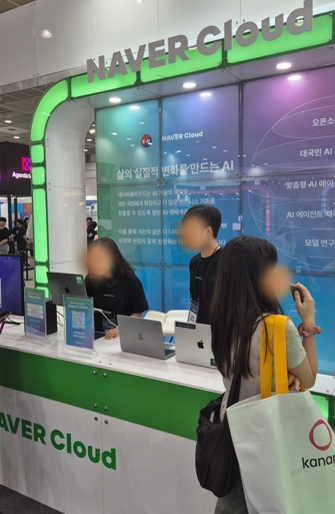
The exhibition did not just showcase AI applications. It emphasized where and how massive data is stored, processed, secured, and scaled. A chatbot, image recognition service, healthcare monitoring system, or enterprise automation tool may look simple on the surface, but behind it there is usually a large cloud environment handling computation and data flow.
This was one of the most practical takeaways from the event. AI grows together with cloud infrastructure. The more AI becomes part of everyday services, the more important reliable servers, fast networks, secure storage, and scalable platforms become. In that sense, cloud booths were not background players. They were showing the foundation that makes many AI services possible.
AI Beyond Algorithms: Human Experience
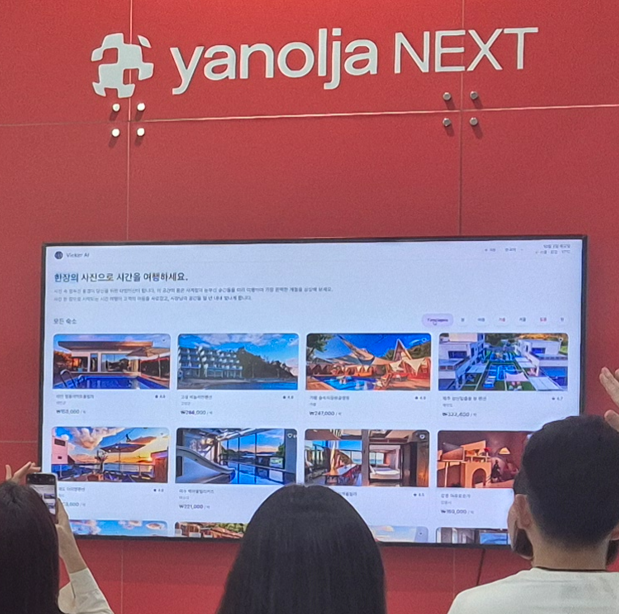
As I explored further, I noticed how AI is evolving into a technology that designs human experiences. Once hidden behind algorithms, AI now interacts directly with human senses: recommending scents, adjusting the lighting in photos by time of day, recognizing faces, supporting voice interfaces, and enabling touch-free holographic interaction.
This shift felt important. People do not usually care about AI because of mathematical models alone. They care when the technology helps them choose, create, move, communicate, learn, heal, or save time. The best booths made that connection visible. They did not only say, "We use AI." They showed what the user could actually do with it.
The event also reminded me that AI experiences need to feel trustworthy. If a system recommends something, people want to know why. If it recognizes a face, people want to know how privacy is protected. If it automates a document, people want to know whether the result can be checked. The more AI enters human experience, the more design, explanation, and responsibility matter.
Healthcare and Compassionate Tech
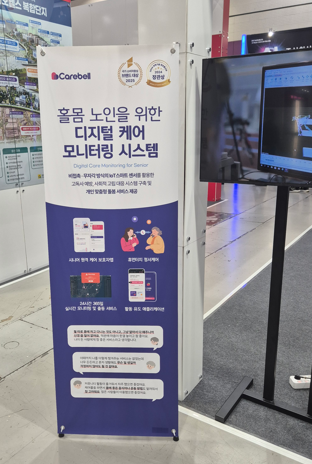
The healthcare section was also remarkable. Exhibits demonstrated AI systems that monitor the health of elderly people living alone, detect unusual patterns, and alert caregivers in advance. Others focused on AI-driven drug discovery and digital health monitoring.
This part left a different impression from the robot or hologram booths. It was less flashy, but more emotionally meaningful. Seeing technology extend from convenience to compassion, into caregiving and medical innovation, made the event feel more grounded. AI was not only being presented as a productivity tool. It was also being presented as something that could help vulnerable people live more safely.
Of course, healthcare AI also raises serious questions. Accuracy, privacy, responsibility, and human oversight are especially important in medical contexts. Still, the direction was encouraging. If AI can help detect risk earlier, support caregivers, reduce repetitive work, or speed up research, then its value becomes much more than convenience.
Insights and Reflections
On the other hand, AI in manufacturing was surprisingly underrepresented. Considering its potential for automation, defect detection, predictive maintenance, process optimization, and smart factories, it seemed like an untapped blue ocean with immense growth ahead.
Manufacturing may not always look as eye-catching in an exhibition hall as robots or consumer demos, but it is one of the areas where AI can create measurable impact. A small improvement in defect detection or equipment maintenance can save time, reduce waste, and improve safety. That is why I expected to see more examples from factories and industrial sites.
At the center of the hall, one phrase stood out to me:
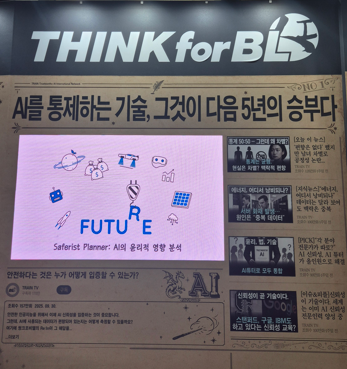
"The technology to control AI - that will define the next five years."
As AI advances rapidly, how we manage and guide it will become the defining challenge of our era. With progress comes responsibility, and the future will depend on how wisely humanity steers this technology.
Overall, the event reminded me that AI is no longer just a tool; it has become part of the infrastructure of modern society. From corporate strategy to public services, education, and healthcare, AI now underpins many layers of innovation. At the core of it all lies data, collected, analyzed, and transformed back into services. This pattern appeared across almost every booth.
I also noticed the pervasive use of QR codes, not only for entry but also for surveys, event participation, and prize draws. Every interaction was digitized, feeding back into data systems for further analysis and follow-up. It was a vivid reminder that even our smallest actions are now part of the data ecosystem.
That observation stayed with me after leaving the hall. We often think of AI as something that starts with a model, but in practice it often starts with data collection. The QR codes, surveys, booth scans, and event participation flows all showed how naturally data is gathered in modern environments.
What Made the Visit Worthwhile
The most valuable part of AI Festa 2025 was not any single booth. It was the overall feeling of seeing many directions at once. Some companies were focused on infrastructure. Some were building user-facing tools. Some were exploring public services, healthcare, security, education, or creative experiences. Together, they created a wider picture of the AI industry.
For someone who is not an AI specialist, this kind of event is useful because it lowers the distance between buzzwords and reality. Words like generative AI, cloud, digital transformation, data platform, automation, and smart service can feel vague when read online. In an exhibition hall, they become booths, screens, staff explanations, demos, devices, and questions.
It also helped me think about how quickly expectations are changing. A few years ago, simply saying that a service used AI was enough to sound new. Now, visitors naturally ask what the AI does, how accurate it is, what data it uses, how it protects privacy, and whether it actually solves a real problem. That is a healthy change.
Final Thoughts
In conclusion, AI Festa 2025 was more than a technology showcase. It was a reflection of where we stand and where we are headed. It made me realize that AI is no longer only an "emerging technology" but a foundation that many future services will build on.
Imagining how these technologies will blend into daily life, perhaps within just a year or two, made this visit especially meaningful. Some ideas still felt experimental, but others already looked close to everyday use. That mix of near future and present reality is what made the expo memorable.
If I had to summarize the visit in one sentence, I would say this: AI is becoming less like a separate technology category and more like a layer that will quietly enter every industry. The important question is no longer whether AI will be used, but how carefully and usefully it will be applied.
Thank you for reading, and I hope you, too, stay inspired by the incredible world of AI!
This article is also available in Korean: Read the Korean version