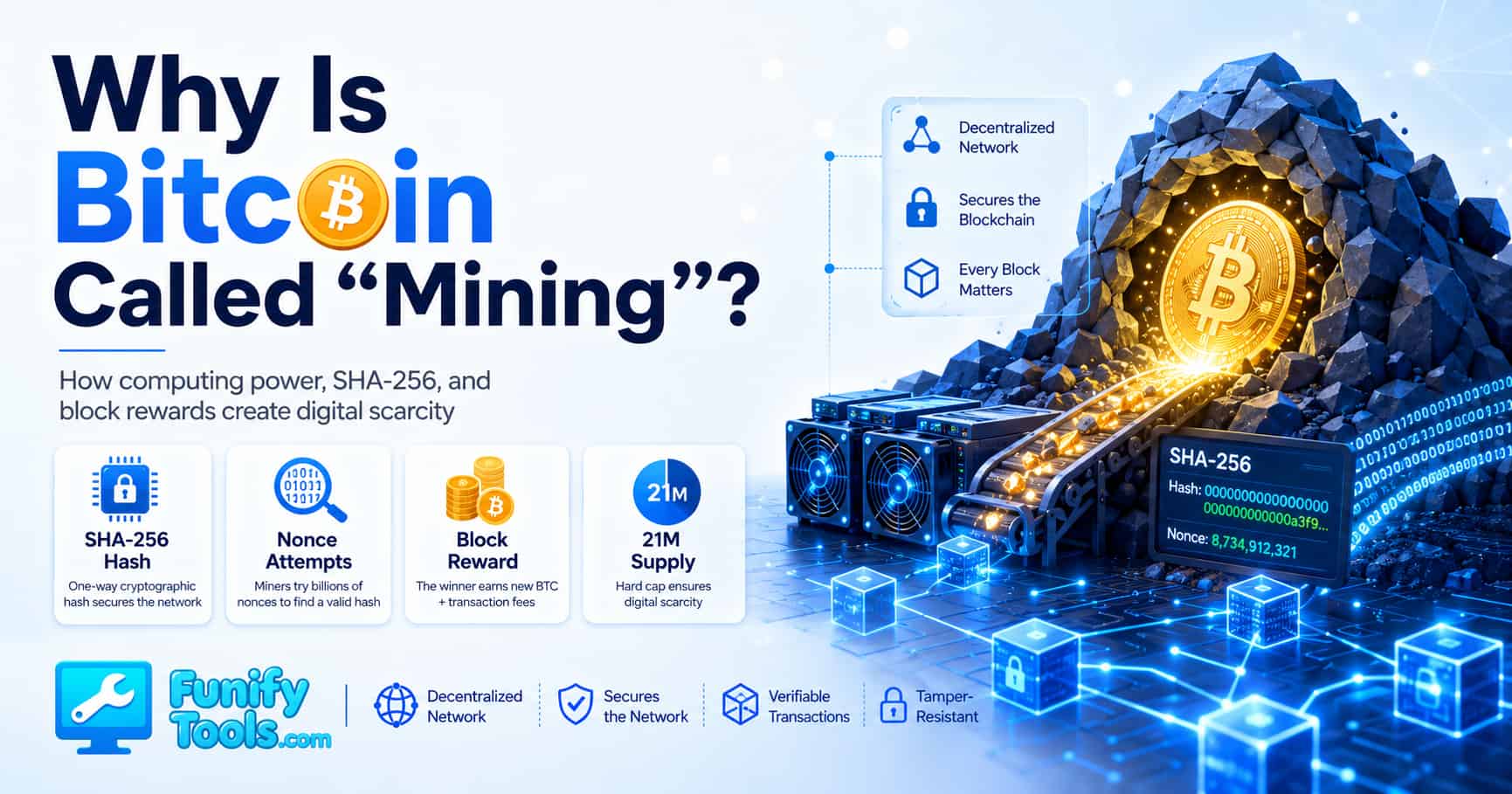
10-second lesson
- Bitcoin is called “mining” because new coins are released through work, competition, and scarcity, much like gold mining.
- Miners are not digging underground; they are using computers to test huge numbers of possible answers.
- The goal is to find a valid hash for a new block of Bitcoin transactions.
- A hash is a fixed-length digital fingerprint made from block data.
- Miners change a small value called a nonce again and again until the hash meets Bitcoin’s difficulty target.
- The first miner to find a valid result can add the block to the blockchain.
- That miner earns newly issued Bitcoin plus transaction fees.
- Mining also protects Bitcoin from fake transactions and double spending.
- The name “mining” is really a metaphor: energy goes in, a scarce reward comes out.
A Closer Look at Why Bitcoin Is Called Mining
Bitcoin mining is one of those phrases that sounds simple until you actually stop and think about it. Nobody is crawling through a cave. Nobody is breaking rocks. No one is pulling shiny orange coins out of the ground. So why do people call it “mining” at all?
The short answer is that Bitcoin borrows the idea of mining from gold. Gold is valuable partly because it is scarce, hard to find, and expensive to extract. Bitcoin was designed with a similar kind of scarcity, but in digital form. New Bitcoin does not appear because a government prints it or because a company decides to issue more. It appears through a competitive process that requires real-world resources: computers, electricity, cooling, hardware, and time.
That process is called mining because it turns effort into a scarce reward. In the physical world, miners spend energy to search for gold. In Bitcoin, miners spend computing power to search for a valid block. The reward is not found in the dirt. It is found inside a mathematical rule.
Bitcoin Needed a Way to Create Money Without a Central Boss
To understand why mining exists, it helps to look at the problem Bitcoin was trying to solve. Traditional money systems have central authorities. A central bank can issue currency. A commercial bank can update your account balance. A payment company can approve, deny, or reverse a transaction. These systems rely on trusted middlemen.
Bitcoin was built to work differently. It is a peer-to-peer digital currency, meaning people can send value across the network without asking a bank to approve the transfer. But that creates a huge question: if there is no central company keeping the master record, who decides which transactions are real?
The answer is the blockchain. Bitcoin keeps a public ledger of transactions, grouped into blocks. Every valid block links to the block before it, creating a chain of records that is extremely hard to rewrite. But someone still has to collect new transactions, check that they follow the rules, and add them to the chain. That job goes to miners.
Mining is not just a coin-making machine. It is the system Bitcoin uses to choose who gets to write the next page of the ledger. The reward is the incentive that makes people want to do that work honestly.
What Miners Are Actually Doing
A Bitcoin miner gathers pending transactions from the network and builds a candidate block. Think of it like preparing a page of records that says, “Here are the transactions I want to add next.” But the miner cannot simply upload that block and call it official. The block has to pass Bitcoin’s proof-of-work test.
Proof of work is the core idea behind mining. The miner must prove that real computational effort was spent before the block can be accepted. This proof comes in the form of a hash that meets a difficulty target.
A hash is a digital fingerprint. You feed data into a hash function, and it produces a fixed-length output that looks random. Bitcoin uses SHA-256 for this process. If even one tiny detail inside the block changes, the resulting hash changes completely. That makes hashes useful for checking whether data has been altered.
For Bitcoin mining, the miner needs a block hash that is low enough to satisfy the current difficulty target. In everyday explanations, people often say the hash needs to start with enough zeros. That is not the full technical picture, but it is a decent mental shortcut. The real rule is that the hash must be below a target value set by the network.
The Nonce: The Number Miners Keep Changing
Here is where the “searching” part begins. Miners cannot control the hash output directly. A hash function does not work like a normal equation where you solve backward and get the answer. You cannot look at the target and neatly calculate the perfect input. You basically have to try, check, fail, and try again.
To create new attempts, miners change a value called the nonce. Nonce stands for “number used once.” It is a small part of the block data that miners can adjust. Every time the nonce changes, the block data changes slightly, and the hash output becomes completely different.
Most attempts fail. Not because the miner made a mistake, but because the odds are intentionally brutal. A miner may test billions or trillions of possibilities and still not find a valid hash. Mining is less like solving a clever puzzle and more like buying a mountain of lottery tickets at machine speed.
This is one of the biggest misconceptions about Bitcoin mining. People often say miners are “solving complex math problems.” That phrase makes it sound like miners are doing algebra homework. They are not. They are repeatedly hashing block data with different values until one output happens to meet the rule. The work is repetitive, mechanical, and extremely resource-intensive.
Why the Winner Gets a Reward
When a miner finally finds a valid hash, the miner broadcasts the block to the rest of the Bitcoin network. Other nodes check it. They verify that the transactions are valid, the block follows the rules, and the proof of work is real. If everything checks out, the block becomes part of the blockchain.
The winning miner receives two kinds of compensation. The first is the block subsidy, which is newly created Bitcoin. The second is transaction fees paid by users whose transactions were included in the block.
This is where the gold-mining comparison becomes clearer. New gold enters the market when miners successfully extract it. New Bitcoin enters circulation when miners successfully add valid blocks. In both cases, the new supply is not free. It takes effort and cost to obtain.
Bitcoin also has a fixed long-term supply limit of 21 million coins. That limit is built into the protocol. Over time, the block subsidy decreases through events called halvings. A halving cuts the new-coin reward roughly every four years, or more precisely every 210,000 blocks. That means Bitcoin becomes harder to issue over time, not because the software is running out of files, but because the rules intentionally slow down new supply.
Difficulty Keeps the System on Schedule
Another important part of mining is difficulty adjustment. Bitcoin is designed so that new blocks are found roughly every ten minutes on average. But miners are always joining, leaving, upgrading hardware, or moving operations. If more computing power joins the network, blocks would be found too quickly unless the system adjusted. If computing power drops, blocks would become too slow unless the system adjusted the other way.
Bitcoin handles this automatically. About every 2,016 blocks, the network looks at how quickly recent blocks were found and adjusts the mining difficulty. If blocks came in too fast, mining gets harder. If blocks came in too slowly, mining gets easier.
This is a big reason the mining metaphor works. In gold mining, easier deposits get exhausted and miners need more effort to find more gold. In Bitcoin, difficulty is not about digging deeper underground. It is about how hard the network makes the hash target. The more total computing power competing, the harder it becomes for any single miner to win.
Mining Is Also Bitcoin’s Security System
The reward is only half the story. Mining is also what makes Bitcoin expensive to attack. To rewrite the blockchain, an attacker would need to redo proof of work and outpace the honest network. That is not just a matter of typing a different number into a database. It would require enormous computing power and electricity.
This is why miners are often described as securing the network. Their machines are not simply hunting for coins. They are making it costly for anyone to fake history. Each new block adds more work on top of the previous block. The deeper a transaction sits in the chain, the harder it becomes to reverse.
That design is clever because it combines incentives with security. Miners want rewards, so they spend resources to compete. The competition creates proof of work. The proof of work protects the ledger. The ledger gives users confidence that Bitcoin transactions cannot be casually edited or duplicated.
In a normal bank, the bank’s internal systems prevent someone from spending the same money twice. In Bitcoin, miners and nodes prevent double spending through public rules and proof of work. No single miner gets to decide everything. A miner can propose a block, but the rest of the network still checks it.
Why Mining Uses So Much Energy
Bitcoin mining uses energy because proof of work is based on real computation. The system intentionally makes block creation costly. That cost is not a bug in the design; it is part of the security model. If creating blocks were free, attackers could spam the network or rewrite history far more easily.
That said, energy use is one of the most debated parts of Bitcoin. Supporters argue that proof of work gives Bitcoin strong neutrality and attack resistance. Critics argue that the electricity demand is too high, especially when compared with more efficient payment systems or other blockchain designs. Both sides usually agree on the basic fact: Bitcoin mining turns electricity into cryptographic security.
For a beginner, the key point is not to treat mining as “computers doing useful calculations for science.” The hash attempts themselves are not curing diseases or rendering movies. Their purpose is to make cheating expensive. The work is useful because the network agrees that this kind of work is the gatekeeping mechanism for adding blocks.
Why Not Just Let Everyone Take Turns?
A natural question is: why does Bitcoin need this expensive competition? Why not let users take turns adding blocks?
The problem is identity. On the internet, one person can create many accounts, computers, or network identities. If Bitcoin simply said “one user gets one vote,” someone could pretend to be a million users. This is sometimes called a Sybil attack. Bitcoin avoids that by making influence depend on proof of work rather than usernames.
In other words, Bitcoin does not ask, “Who are you?” It asks, “Can you prove you spent real computational effort?” That is much harder to fake at scale. You can create unlimited usernames, but you cannot fake the electricity, hardware, and hash power needed to compete with miners around the world.
Mining Pools: Why Most Miners Team Up
In the early days, a person could mine Bitcoin with a normal computer. That is no longer realistic for most people. Mining has become extremely competitive, and specialized hardware called ASIC miners dominates the network. These machines are built for one main purpose: calculating Bitcoin hashes as fast and efficiently as possible.
Because the chance of one small miner finding a block alone is tiny, many miners join mining pools. A mining pool combines hash power from many participants. If the pool finds a block, the reward is shared among members based on how much work they contributed.
This makes payouts more predictable. Solo mining is like waiting for a rare jackpot. Pool mining is more like receiving smaller, steadier payments. The basic mining process is the same, but the reward is split across many contributors.
The Gold Comparison Is Useful, but Not Perfect
The word “mining” is a metaphor, not a perfect match. Gold is a physical material. Bitcoin is digital. Gold exists in the earth before anyone finds it. Bitcoin is issued according to software rules when blocks are added. Gold mining produces metal that can be used in jewelry, electronics, and industry. Bitcoin mining produces ledger security and releases digital units into circulation.
Still, the comparison works because both systems connect scarcity with effort. Gold is not valuable only because people want it. It is also difficult to obtain. Bitcoin’s supply is not controlled by a company that can casually create more. New Bitcoin arrives slowly, competitively, and predictably through mining.
That predictability is one of Bitcoin’s most unusual traits. Everyone can check the rules. Everyone can see the supply schedule. No miner can decide to create extra Bitcoin outside the protocol. If a miner tries to include an invalid reward, nodes reject the block. The system is strict because the rules are public and constantly verified.
Mining, Nodes, and the Difference Between Them
It is also worth separating miners from nodes. A miner performs proof of work and tries to add new blocks. A node keeps a copy of the blockchain and checks whether blocks and transactions follow Bitcoin’s rules. Some miners run nodes, and many non-miners run nodes too.
This distinction matters because miners do not have unlimited power. A miner can find a block, but nodes decide whether that block is valid. If a miner creates a block with fake coins, invalid transactions, or broken rules, honest nodes can reject it. Mining gives someone a chance to propose the next block. It does not give them permission to rewrite Bitcoin’s rules by themselves.
That is part of what makes Bitcoin decentralized. The system is not just “miners control everything.” It is a balance between miners who provide proof of work, nodes who verify rules, and users who choose which software and network rules they recognize.
So Why Is It Called Mining?
Bitcoin is called mining because the process looks a lot like resource extraction when you zoom out. Miners spend energy. They compete against each other. They search through a huge space of possibilities. Most attempts produce nothing. Occasionally, one attempt hits the target. When that happens, the miner earns a scarce reward.
The reward is not just payment for luck. It is payment for participating in the security of the network. Mining creates new coins, confirms transactions, and makes the blockchain difficult to tamper with. Those three ideas are tied together. Bitcoin does not have one separate system for issuing coins and another separate system for securing the ledger. Mining does both at once.
That is the real reason the term stuck. “Mining” captures the feel of the process better than a dry technical phrase would. It suggests effort, cost, competition, rarity, and discovery. Even though the work happens inside machines instead of mountains, the basic idea is familiar: you put in resources, and if you are lucky enough to find what the system is looking for, you get the reward.
So when someone says Bitcoin is mined, they do not mean coins are hidden somewhere on the internet waiting to be dug up. They mean new Bitcoin is released through proof of work. Miners are searching for valid hashes, not treasure chests. But because the reward is scarce and the search requires real effort, “mining” is still the word that makes the most sense.
This article is also available in Korean: Read the Korean version