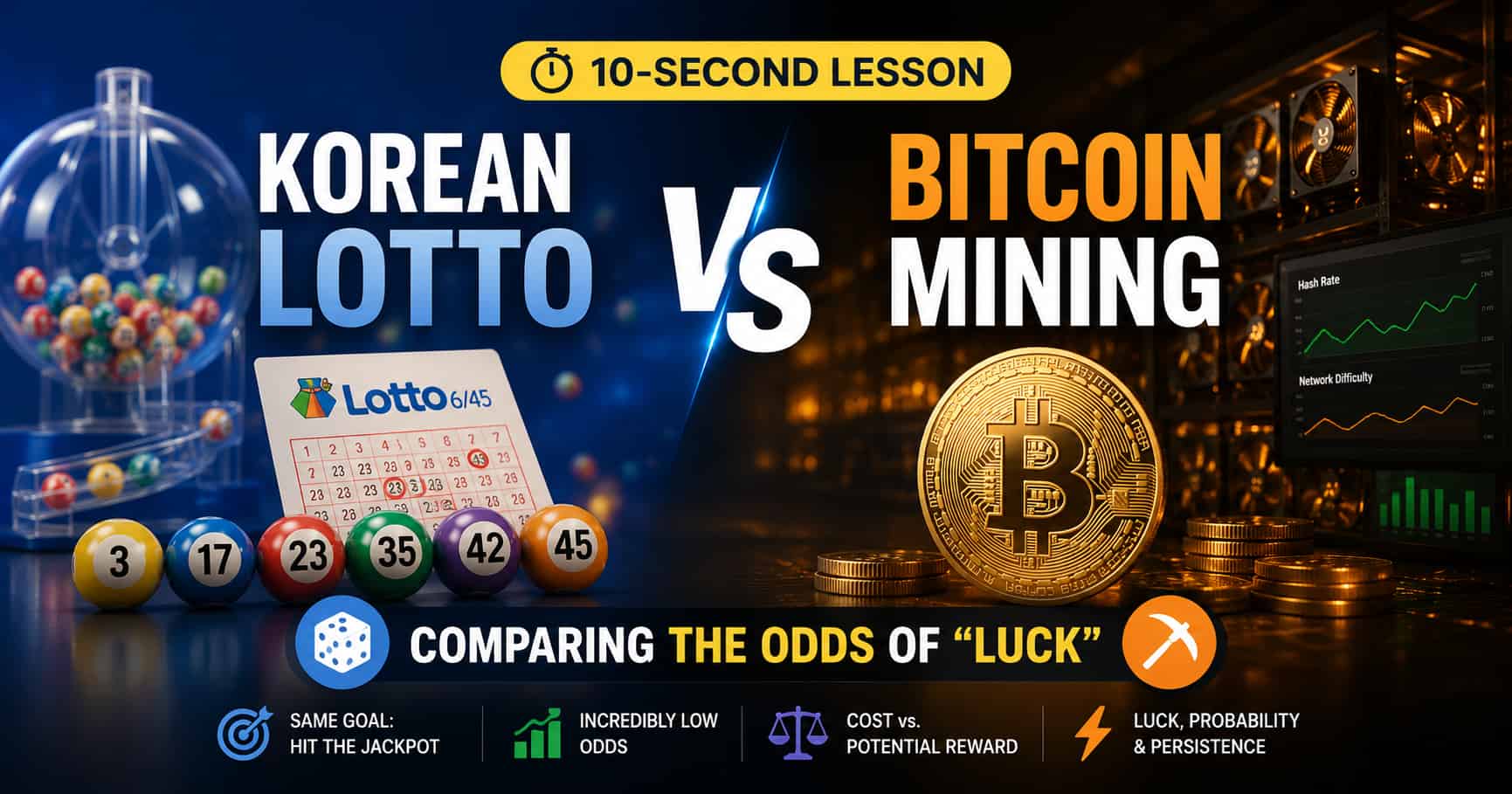
10-second lesson
- The Korean Lotto and Bitcoin mining both involve chance, but they work in very different ways.
- In the Korean Lotto, one ticket chooses 6 numbers out of 45, and the first-prize odds are 1 in 8,145,060.
- Buying more tickets gives you more chances, but it does not change the odds of each individual ticket.
- Bitcoin mining is more like a nonstop digital lottery where machines keep guessing hashes.
- A miner wins a block only when it finds a hash that satisfies the current Bitcoin network difficulty.
- More hash power means more attempts per second, but the global competition is enormous.
- CPU and GPU mining are no longer realistic for Bitcoin because specialized ASIC machines dominate the network.
- The simple comparison: Lotto is luck with numbered tickets; Bitcoin mining is luck multiplied by hardware, electricity, and scale.
Why Lotto and Bitcoin Mining Both Depend on Probability
At first, the Korean Lotto and Bitcoin mining seem like completely different worlds. One is a weekly lottery ticket. The other is a global computing network. But underneath the surface, both are built around probability. The difference is how the chances are created.
In the Korean Lotto, the rules are easy to see. You choose 6 numbers out of 45. If all six match the drawn numbers, you win first prize. There is no strategy that can make one combination meaningfully smarter than another. Every valid combination has the same chance.
The Korean Lotto Is a Fixed-Rule Lottery
The first-prize odds for the Korean Lotto are 1 in 8,145,060. That number comes from the number of possible ways to choose 6 numbers from 45. If you buy one ticket, you own one combination. If you buy five tickets, you own five combinations.
Buying five tickets is better than buying one, but it still does not make the lottery likely. It only gives you five chances out of more than eight million possible combinations. The odds are still extremely small.
This is why the Lotto is pure chance. Your ticket does not work harder. It does not improve over time. It simply waits for the draw. Once the numbers are selected, your combination either matches or it does not.
Bitcoin Mining Is a Digital Lottery
Bitcoin mining also depends on chance, but it does not happen once a week. It happens constantly. Miners around the world run specialized machines that try huge numbers of hash guesses. Each guess is like a tiny lottery ticket.
The goal is to find a hash that meets the Bitcoin network's current difficulty target. If a miner finds a valid hash first, that miner can add the next block and receive the block reward and transaction fees.
Unlike the Lotto, Bitcoin mining is not based on buying a fixed number of paper tickets. It is based on how many guesses your hardware can make per second. More hash power means more attempts, which means a larger share of the total chance.
Why Ordinary Computers Cannot Compete
In the early days of Bitcoin, people could mine with normal CPUs. Later, GPUs became common. Today, Bitcoin mining is dominated by ASIC miners, which are machines built specifically for SHA-256 hashing.
A normal desktop CPU or gaming GPU can still perform calculations, but it is tiny compared with the industrial hash power of modern Bitcoin mining. Competing with the global network using ordinary hardware is like entering a race on foot while everyone else is driving purpose-built machines.
This does not mean the computer is doing nothing. It is still making attempts. The problem is scale. The Bitcoin network adjusts difficulty so blocks are found at a fairly steady pace, and the total global competition is massive.
Luck Plus Cost
The Lotto costs money per ticket. Bitcoin mining costs money in a different way: hardware, electricity, cooling, maintenance, and operational risk. A miner can make many more attempts than a Lotto player, but those attempts are not free.
This is why mining is not simply a matter of better odds. It is an economic calculation. A miner has to compare expected rewards with energy costs, hardware costs, network difficulty, Bitcoin price, and competition from other miners.
Solo mining is especially difficult because one miner has to find a block alone. Many miners join mining pools, where participants combine hash power and share rewards based on contribution. This makes income more predictable, though each person receives only a fraction of the reward.
One Important Difference
The Korean Lotto exists mainly as a game of chance. Bitcoin mining also has a lottery-like element, but it serves a network function. Mining helps confirm transactions, add blocks, and secure the Bitcoin blockchain.
That means a failed mining attempt is not exactly the same as a losing lottery ticket. The miner's machine is participating in a global security process, even if it does not win the next block. Still, from the individual miner's point of view, winning a block is a probability event.
The Simple Version to Remember
The Korean Lotto is a slow lottery with fixed odds. Bitcoin mining is a fast lottery where machines make repeated guesses, and the chance of winning depends on your share of global hash power.
Both involve luck, but Bitcoin mining adds engineering and economics. Lotto asks whether your numbers matched. Mining asks whether your hardware found the right hash before everyone else. In both cases, the odds remind us how powerful probability can be.
This article is also available in Korean: Read the Korean version