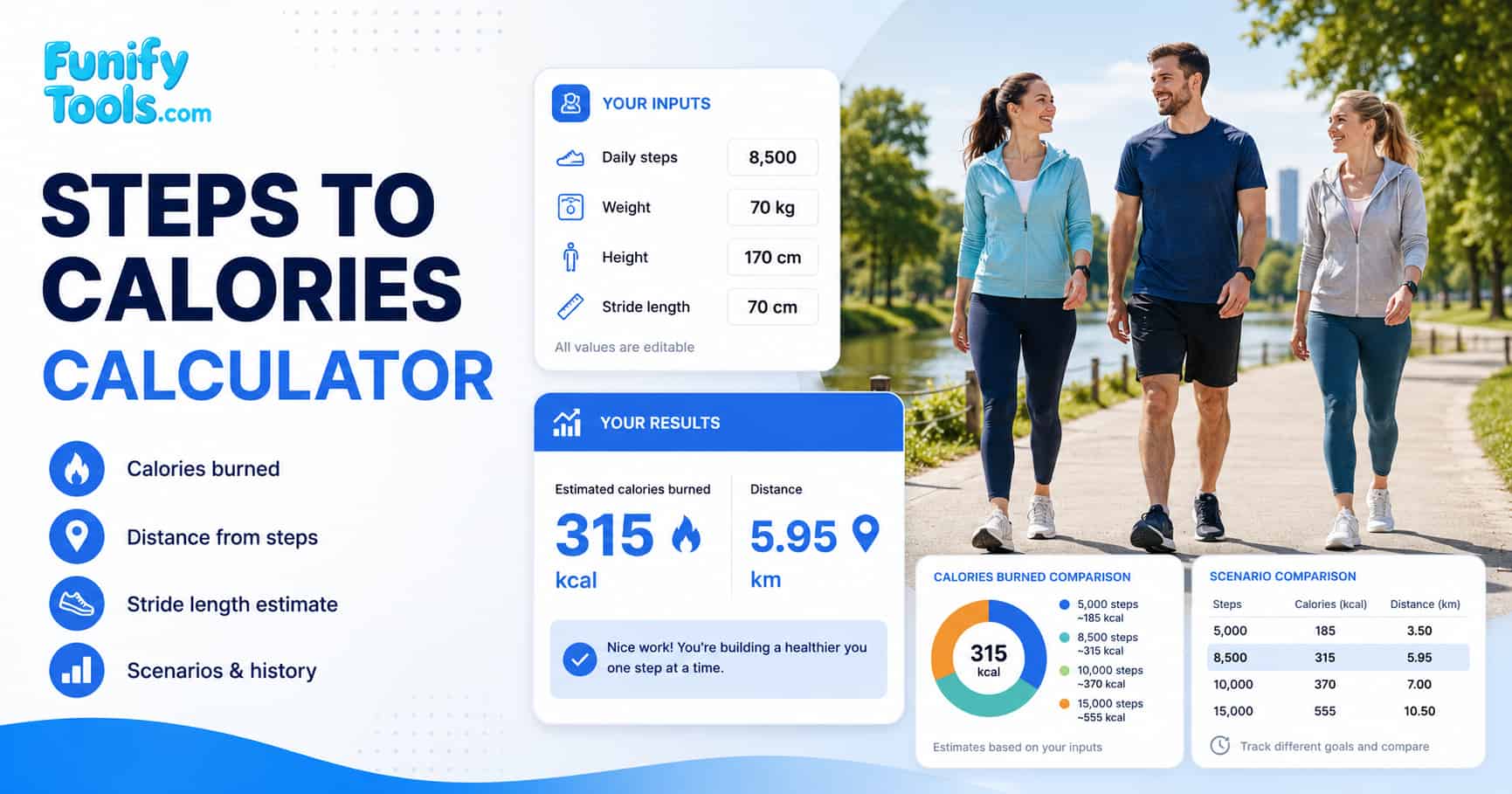
What this calculator does
The Steps to Calories Calculator is a practical fitness tool that estimates the number of calories you burn based on your daily step count, body weight, height, and stride length. Walking is one of the most accessible forms of physical activity, and converting steps to calories can make daily movement easier to understand.
The calculator first converts your total steps into walking distance using the distance covered per step. It then applies a simple walking energy factor to estimate calorie expenditure. Whether you are tracking daily steps for weight loss, training for a walking event, or simply curious about how many calories your morning walk burns, this tool delivers a quick and reliable reference point.
Use the result for planning and trend tracking rather than medical measurement. It can help you compare 5,000, 10,000, or 15,000 step days, set realistic walking goals, and see how body weight and stride length change the final estimate.
Formula used
The calorie estimate is calculated using a straightforward walking energy model that balances simplicity with practical accuracy. All input values are converted internally to metric units (centimeters for height and stride length, kilograms for weight) to keep the formula consistent.
The core factor, 0.57 kilocalories per kilogram per kilometer, represents a typical estimate for moderate walking on level ground. Real calorie burn can be higher or lower depending on pace, grade, surface, load, and individual movement efficiency.
Because the formula is intentionally simple, it is easy to audit: steps become distance, and distance plus body weight becomes calories.
| Step | Formula | Note |
|---|---|---|
| Distance | Steps x stride length (cm) / 100000 | Returns kilometers. |
| Calories | Distance (km) x weight (kg) x 0.57 | Uses a typical moderate walking estimate. |
| Stride estimate | Height (cm) x 0.414 | Used only when stride length is left blank. |
Stride length
This calculator uses stride length to mean the distance covered by one step. Some technical sources define stride as a two-step cycle, but many step calculators and fitness guides use the term for per-step distance. The formula on this page follows the per-step convention.
When you do not provide a specific value, the calculator estimates stride length from height using a 0.414 ratio. This is a useful average, but your actual value can differ because of leg length, walking style, pace, and flexibility.
For a more personalized estimate, measure your own stride length at your normal walking pace. If you are interested in learning how to measure stride length for walking accurately, the simple method below will give you a personalized value that improves the precision of your calorie estimate.
How to measure your stride
- Walk 10 steps at a normal pace.
- Measure total distance in centimeters.
- Divide by 10 to get stride length per step.
Accuracy factors
While the Steps to Calories Calculator provides a practical estimate for moderate walking on level ground, it is important to recognize that real-world calorie burn is influenced by several additional variables. Walking speed matters, and hills, stairs, sand, grass, or gravel can increase energy cost compared with flat pavement.
Biomechanics also matter. Gait efficiency, leg length, joint mobility, footwear, and the weight of anything you carry can change how much energy you use to cover the same distance. Age, sex, muscle mass, and fitness level can also affect individual results.
For a broader comparison of activities, you may find it helpful to explore calories burned per activity comparison resources online. For the most consistent trend data, use the same step-tracking device and the same measurement method each day.
Example estimates
The following examples illustrate how body weight directly influences total calorie burn over a given walking distance. These estimates assume moderate walking on level ground and use the same 0.57 kcal per kg per km factor that powers the calculator.
Notice how a 90 kg person burns more calories than a 50 kg person over the same distance. Walking is weight-bearing, so moving more body mass requires more energy. The same logic also means that calorie burn from the same walk may decrease as body weight decreases.
| Body weight | About kcal per 1 km | About kcal for 8 km |
|---|---|---|
| 50 kg | 28.5 kcal | 228 kcal |
| 70 kg | 39.9 kcal | 319 kcal |
| 90 kg | 51.3 kcal | 410 kcal |
Keep in mind that your actual distance per 10,000 steps depends on your unique stride length, so your personal 10,000-step calorie result may differ from the examples above. For the most accurate and personalized estimate, use the calculator with your own weight, height, and stride length measurements.
Calories per step by weight
While a single step burns only a tiny fraction of a calorie, the cumulative effect of thousands of steps throughout the day adds up to a meaningful contribution to your total daily energy expenditure. The table below provides approximate values for calories burned per individual step and per 1,000 steps across a range of body weights. These values assume a 70 cm step length, matching the milestone table below.
The per-step numbers are small, but adding 2,000 to 3,000 extra steps through short walking breaks can still make a useful difference over time. For best results, combine step goals with balanced nutrition, hydration, sleep, and strength or mobility work.
| Body weight | Calories per step (approx) | Calories per 1,000 steps |
|---|---|---|
| 50 kg (110 lb) | 0.020 kcal | 20 kcal |
| 60 kg (132 lb) | 0.024 kcal | 24 kcal |
| 70 kg (154 lb) | 0.028 kcal | 28 kcal |
| 80 kg (176 lb) | 0.032 kcal | 32 kcal |
| 90 kg (198 lb) | 0.036 kcal | 36 kcal |
Weight impact on calorie burn
Body weight is one of the most significant determinants of energy expenditure during any weight-bearing activity, and walking is no exception. A heavier individual must expend more energy to move their body mass over the same distance, which means that two people walking side by side can have different calorie burn totals.
In this calculator, the relationship is linear: if body weight rises by 20 percent, estimated calories per kilometer also rise by about 20 percent, assuming distance and walking conditions stay the same. The table below shows how the same distance produces different calorie outcomes for three body weights.
| Distance walked | 50 kg person | 70 kg person | 90 kg person |
|---|---|---|---|
| 2 km (about 2,500–3,000 steps) | 57 kcal | 80 kcal | 103 kcal |
| 5 km (about 6,000–7,500 steps) | 143 kcal | 200 kcal | 257 kcal |
| 8 km (about 10,000–12,000 steps) | 228 kcal | 319 kcal | 410 kcal |
| 10 km (about 12,500–15,000 steps) | 285 kcal | 399 kcal | 513 kcal |
Step milestone comparison
Setting daily step milestones is one of the most popular and effective ways to maintain an active lifestyle. Goals such as 5,000, 8,000, 10,000, 12,000, and 15,000 steps provide a clear and measurable framework for gradually increasing your physical activity level over time.
The 10,000-step target is a familiar benchmark, but it is not a magic cutoff. For many people, moving from a sedentary baseline to 5,000-7,000 daily steps can already be meaningful, while higher goals may fit active walkers and hikers.
The table below compares estimated calorie burn at common step milestones for three body weights. It assumes a 70 cm step length, which is a reasonable reference for a person around 170 cm tall. Use the calculator with your own measurements for a more personal estimate.
| Step milestone | Approx. distance | 50 kg person | 70 kg person | 90 kg person |
|---|---|---|---|---|
| 5,000 steps | 3.5 km | 100 kcal | 140 kcal | 180 kcal |
| 8,000 steps | 5.6 km | 160 kcal | 224 kcal | 288 kcal |
| 10,000 steps | 7.0 km | 200 kcal | 280 kcal | 360 kcal |
| 12,000 steps | 8.4 km | 240 kcal | 336 kcal | 432 kcal |
| 15,000 steps | 10.5 km | 300 kcal | 420 kcal | 540 kcal |
These milestone values are estimates based on the same 0.57 kcal per kg per km factor that powers the calculator. Your actual results will vary depending on your exact stride length, walking speed, terrain, and individual physiology. Use this milestone table as a quick reference, and rely on the calculator inputs for your daily walking calorie estimate.
Practical tips
- Wear a consistent step tracker: Use the same device, worn in the same location (wrist, hip, or pocket), to ensure reliable day-to-day comparisons. Different trackers can produce different step counts for the same activity.
- Keep your weight updated: Enter an accurate current weight for the best estimates, and update it periodically as your body weight changes. Even small changes of 1 to 2 kg can affect your calorie burn calculation.
- Measure your stride for precision: If you know your actual stride length from a simple measurement test, input it directly into the calculator for higher accuracy rather than relying on the height-based estimate.
- Use scenario comparison: Add different scenarios to compare calorie burn across different days, walking routes, or step goals. This helps you identify patterns in your activity and understand how changes in your routine affect your energy expenditure.
- Combine walking with other exercise: For a well-rounded fitness routine, complement your daily walking with strength training exercises, stretching or yoga for flexibility, and other cardiovascular activities such as cycling, swimming, or jogging.
- Track your trends over time: Use the Funify Notes feature to save your calculation history and review your progress over weeks and months. Seeing your improvement over time can be a powerful motivator to stay consistent with your walking routine.
All results are estimates and may differ from actual calorie burn due to walking speed, terrain gradient, gait mechanics, and individual metabolic variability. Use this tool as part of a comprehensive approach to health and fitness tracking that also includes proper nutrition, hydration, sleep, and stress management.
References
Wikipedia: Calorie | Wikipedia: Stride length | Walking MET values and energy expenditure | CDC: Measuring Physical Activity | WHO: Physical Activity Fact Sheet