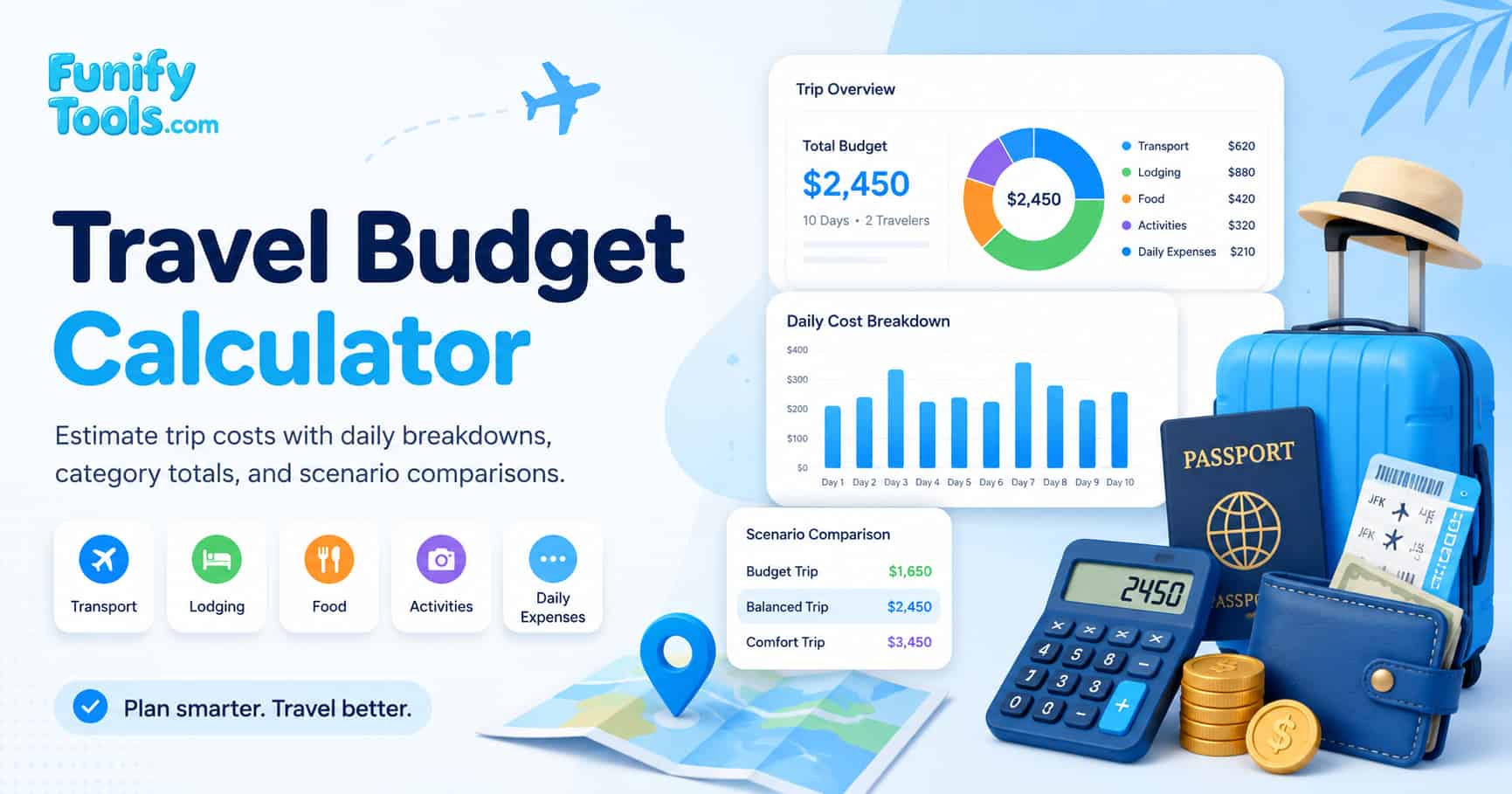
What this travel budget calculator does
The Travel Budget Calculator is a free online trip planning tool that helps you estimate the total cost of any multi-day trip by combining one-time transportation expenses with daily costs for accommodation, food, activities, and miscellaneous spending. Unlike generic budgeting spreadsheets, this calculator applies dynamic multipliers based on three daily factors: weather, daily schedule, and travel style, to produce a realistic, day-by-day cost breakdown that adapts to your itinerary.
Whether you are planning a weekend city break, a week-long beach vacation, or a month-long backpacking adventure across multiple countries, this tool gives you a structured estimate that accounts for how each day's conditions affect your spending. Use it as an itinerary planning tool before you book flights, compare accommodation options on booking platforms, or decide how much cash buffer to keep for unexpected expenses during a multi-day trip. To get the most accurate base prices, search average hotel cost per night by destination to see what other travelers are paying in your chosen city before entering your accommodation base rate.
Unlike a live fare search engine or a travel booking aggregator, this page does not fetch real-time prices from airlines, hotels, or tour operators. You enter your own cost assumptions based on your research, and the calculator turns them into a structured estimate with category totals, average daily cost, daily rows, interactive charts, recent calculations on your device, scenario comparison across multiple budget versions, and an automatically saved record in Funify Notes for later reference.
Core formulas used in the travel budget calculation
The calculator separates one-time transportation from repeated daily costs. Each daily cost is adjusted first by travel style, then by weather and schedule factors, and finally all category totals are summed together.
transportation + accommodation + food + activities + miscellaneous
total trip cost ÷ trip daysbase food × style × weather food factor × schedule food factor
base activities × style × weather activity factor × schedule activity factor
base accommodation × stylebase miscellaneous × style × schedule miscellaneous factor
Adjustment rules used in this calculator
The calculation logic preserves the proven travel budget behavior from the original version. Each day starts from the base accommodation, food, activities, and miscellaneous amounts you provide. Travel style scales the entire day's costs as a broad multiplier, while weather and schedule apply targeted percentage changes to specific spending categories. Understanding these rules helps you make informed choices when setting daily conditions for each day of your trip.
Travel style multipliers
Travel style represents your overall spending comfort level and applies uniformly across all daily costs. A budget-conscious traveler might choose the 0.8x multiplier to reflect hostel stays, street food, and free attractions, while a luxury traveler selects 1.5x or 2.0x for premium hotels, fine dining, and exclusive tours.
- Budget (0.8x): Ideal for backpackers, student travelers, and cost-conscious trips where every dollar counts.
- Mid-range (1.0x): The neutral baseline representing moderate hotels, casual dining, and a balanced mix of paid and free activities.
- Luxury (1.5x): Suitable for travelers who prefer upscale hotels, nicer restaurants, and guided tours without worrying about minor costs.
- Ultra-luxury (2.0x): For premium travel experiences with five-star accommodations, private transfers, and exclusive access to top attractions.
Weather adjustments
Weather conditions directly influence how much you are likely to spend on food and activities. For example, sunny weather encourages outdoor excursions and paid attractions, while rainy or stormy conditions shift spending toward indoor dining and reduce activity costs.
| Weather | Food factor | Activities factor | Planning meaning |
|---|---|---|---|
| Sunny | 1.0x | 1.2x | More outdoor attractions and paid activities |
| Partly cloudy | 1.0x | 1.1x | Slightly higher activity spending |
| Cloudy | 1.1x | 1.0x | Neutral activities with slightly higher food spending |
| Rainy | 1.2x | 0.8x | Fewer outdoor activities and more indoor breaks |
| Stormy | 1.3x | 0.5x | Reduced activity spending with more indoor meals or waiting time |
Schedule adjustments
Your daily schedule defines the primary purpose of each trip day. A sightseeing day typically involves entrance fees, guided tours, and transportation between attractions, while a relaxation day may involve free beach time or poolside lounging. The schedule factors adjust activities, food, and miscellaneous costs accordingly.
| Schedule | Activities factor | Food factor | Miscellaneous factor |
|---|---|---|---|
| Sightseeing | 1.3x | 1.1x | 1.0x |
| Relaxation | 0.5x | 0.9x | 0.8x |
| Adventure | 1.5x | 1.2x | 1.1x |
| Cultural | 1.1x | 1.0x | 1.2x |
| Shopping | 0.8x | 1.0x | 1.5x |
| Transit | 0.8x | 0.8x | 1.0x |
How daily factors change the budget
Understanding how weather, schedule, and travel style interact is key to getting the most accurate estimate from this travel budget calculator. Each factor plays a distinct role in shaping your daily spending profile.
Weather changes the realism of your activity plan. A sunny sightseeing day may include museums, guided tours, taxis between attractions, and paid outdoor activities such as boat rides or zip-lining. In contrast, a stormy day may force you to cancel outdoor excursions, but the calculator compensates by increasing food costs, reflecting the tendency to spend more time in cafes, restaurants, or ordering delivery during inclement weather.
Schedule choices describe the primary purpose of each day. Adventure and sightseeing days tend to cost significantly more than transit or relaxation days because of higher activity fees and meal expenses. Shopping days may not increase attraction ticket costs, but the miscellaneous category rises because the calculator treats purchases, souvenirs, and small extras as a larger planning bucket. Cultural days often involve museum entry fees and donations, reflected in a moderate activities multiplier.
Travel style is the broadest multiplier and affects every cost category. A budget plan assumes low-cost meals, shared accommodation, and free or discounted activities. Luxury and ultra-luxury plans intentionally widen the estimate so the trip does not look artificially cheap. This prevents the common mistake of underestimating a trip and running out of funds mid-journey.
Typical base costs to research before using the calculator
Before entering numbers into the calculator, gather rough price estimates for your destination and travel season. Accurate base costs lead to more reliable results. You can search for flight price trends to your destination to understand seasonal airfare patterns, compare hotel taxes and resort fees by destination to avoid surprise charges, and check local transportation pass prices for daily transit costs before finalizing your base inputs. These quick searches help you build a realistic foundation for your travel budget.
| Category | What to research | Common hidden cost |
|---|---|---|
| Transportation | Flights, trains, ferries, fuel, airport transfers | Baggage fees, seat fees, airport rail or taxi |
| Accommodation | Hotel, hostel, rental, service fees, taxes | Resort fee, cleaning fee, city tax |
| Food | Meals, snacks, drinks, local dining habits | Tips, delivery fees, breakfast not included |
| Activities | Museums, tours, passes, entrance tickets | Reservation fees, equipment rental, local guide fees |
| Miscellaneous | SIM card, laundry, shopping, small emergencies | Currency exchange spread, lockers, adapters |
Sample budget estimates by destination type
The table below shows typical daily cost ranges for different travel styles across common destination types. Use these figures as a starting point when entering your base costs into the calculator. Actual prices vary by season, location within a country, and your personal spending habits.
| Destination type | Budget (per day) | Mid-range (per day) | Luxury (per day) |
|---|---|---|---|
| Southeast Asia (Thailand, Vietnam, Indonesia) | $30-$50 | $60-$100 | $150-$250 |
| Europe (France, Italy, Spain) | $70-$100 | $120-$200 | $300-$500 |
| North America (USA, Canada) | $80-$120 | $150-$250 | $400-$700 |
| South America (Peru, Colombia, Brazil) | $40-$70 | $80-$130 | $200-$350 |
| Africa (Kenya, South Africa, Morocco) | $50-$80 | $90-$150 | $250-$450 |
| Middle East (UAE, Turkey, Egypt) | $50-$80 | $100-$180 | $300-$600 |
Seasonal cost variations and their impact on your travel budget
Travel costs are not static throughout the year. Peak season months, such as summer in Europe, December holidays in the Caribbean, or cherry blossom season in Japan, can drive accommodation prices up by 50 percent or more compared to the off-season. The table below shows how the same destination type can vary across different travel seasons, helping you decide when to travel for the best value.
| Destination type | Peak season premium | Shoulder season | Off-season discount |
|---|---|---|---|
| Southeast Asia | Nov-Feb (dry) +30% | Mar-May, Sep-Oct | Jun-Oct (rainy) -20% |
| Europe | Jun-Aug (summer) +50% | Apr-May, Sep-Oct | Nov-Mar (winter) -30% |
| North America | Jun-Aug (summer) +40% | Mar-May, Sep-Nov | Dec-Feb (winter) -25% |
| Caribbean | Dec-Apr (dry) +60% | May-Jun, Nov | Jul-Oct (hurricane) -35% |
| Japan | Mar-Apr (cherry blossom) +45% | May-Jun, Oct-Nov | Dec-Feb (winter) -20% |
When planning your trip, consider searching for the best time to visit your destination for cheap travel to align your dates with lower rates. This is especially important for accommodation, which is often the largest daily expense in any travel budget.
Planning workflow for best results
Follow this step-by-step workflow to get the most out of the Travel Budget Calculator and build a reliable trip estimate you can confidently use for planning.
- Enter a conservative first estimate so the trip does not look cheaper than it will be. It is better to overestimate slightly and have funds left over than to underestimate and face financial stress during your travels.
- Set the trip duration and review whether each generated day matches the real itinerary. If you have travel days with minimal activity, mark them as Transit days for more accurate results.
- Use scenario comparison to test a budget version, a mid-range version, and a higher comfort version of the same trip. This helps you understand the financial range and decide which trade-offs matter most to you.
- Review the category share bars to see whether transportation, lodging, or daily spending dominates the plan. If one category is disproportionately high, consider ways to reduce it, such as choosing a cheaper flight route or booking accommodation outside the city center.
- Save the result to Funify Notes and revisit it after checking actual booking prices. Update your base costs as you gather real quotes from airlines, hotels, and tour operators to refine the estimate over time.
References and further reading
Wikipedia: Travel | Wikipedia: Budget | Wikipedia: Travel insurance