Why this calculator helps
Auto loan offers are often compared by monthly payment only. That is useful, but it does not tell the full story. A lower payment can come from a longer term, which often increases total interest. Understanding the full cost of an auto loan requires examining the interplay between the interest rate, loan duration, down payment amount, and local tax regulations. Many car buyers focus solely on the affordability of the monthly payment, but overlooking the total interest paid over the life of the loan can lead to paying thousands of dollars more than necessary.
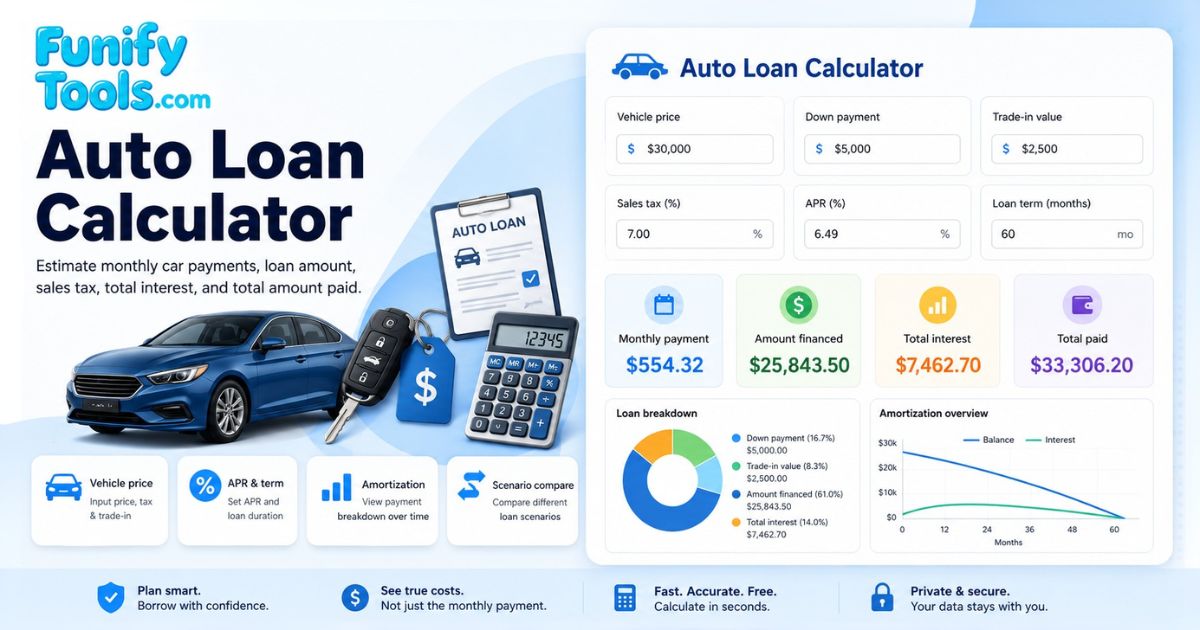
This calculator shows the payment and the total cost together so you can compare trade-offs more clearly. It also separates loan amount, sales tax, and interest to make the financing math easier to understand. By providing a comprehensive breakdown of each component, the tool empowers you to make informed financial decisions when purchasing a vehicle. Whether you are a first-time car buyer or refinancing an existing loan, having a clear picture of the numbers helps you negotiate with confidence at the dealership.
If you are comparing dealer offers, Google results for auto loan monthly payment and total interest calculators can help you check whether the payment and total cost move in the same direction. Additionally, Google results for best auto loan rates by credit score provide useful benchmarks when evaluating lender offers.
Inputs and assumptions
The calculator uses a simple set of inputs commonly seen on car financing worksheets. Each input plays a distinct role in determining the final loan estimate, and understanding how they interact is key to accurate planning.
- Vehicle price is the purchase price before loan financing. This is the starting point for all calculations and directly affects the loan amount and sales tax.
- Down payment is cash paid upfront to reduce the amount financed. A larger down payment reduces the principal balance, which in turn lowers the monthly payment and total interest charges.
- Trade-in value is value credited from your current vehicle toward the purchase. Depending on local tax rules, a trade-in may also reduce the taxable portion of the sale.
- Sales tax rate is the local tax rate used to estimate tax added to the deal. Sales tax can add a significant amount to the total cost, especially in states or regions with rates above 8%.
- APR is the annual percentage rate for the loan. This represents the cost of borrowing and includes both the interest rate and any lender fees expressed as an annualized percentage.
- Loan term is the number of monthly payments. Common terms range from 36 to 84 months, with longer terms offering lower payments but higher total interest costs.
This page assumes sales tax is applied to vehicle price minus trade-in value. That is common in some places, but not universal. Dealer fees, registration, insurance, and lender fees are not included. For a more accurate estimate, you can add estimated dealer fees and registration costs to the vehicle price field manually.
| Input | What it changes | Cost effect |
|---|---|---|
| Vehicle price | Base purchase amount | Higher price usually raises tax, loan amount, and payment. |
| Down payment | Cash paid upfront | Higher down payment lowers amount financed. |
| Trade-in value | Credit from current car | Can reduce taxable amount and loan amount depending on local rules. |
| Sales tax rate | Estimated tax added to the purchase | Higher tax increases the amount that may be financed. |
| APR | Borrowing rate | Higher APR raises monthly interest and total interest. |
| Loan term | Number of monthly payments | Longer terms often lower payment but increase total interest. |
Formulas and workflow
The calculator starts by estimating the taxable amount and the amount financed, then applies fixed-rate amortization to the loan amount. This approach follows standard auto lending practices used by banks, credit unions, and captive finance companies.
taxable amount = max(vehicle price - trade-in value, 0)
sales tax = taxable amount x tax rate
loan amount = vehicle price + sales tax - down payment - trade-in value
For standard fixed-rate auto loans, each monthly payment includes both principal and interest. The calculator uses the common amortization formula. Over the life of the loan, the portion of each payment allocated to interest gradually decreases while the principal portion increases, a process known as amortization.
r = APR / 12
P = (PV x r x (1 + r)^n) / ((1 + r)^n - 1)
total interest = monthly payment x n - loan amount
If APR is 0%, the calculator simply divides the loan amount by the number of months. Zero-percent financing offers are common on new vehicles during promotional periods, but they may require a higher down payment or a shorter term to qualify.
For more background on the payment formula, Google results for loan amortization formula monthly payment APR explain how principal and interest are blended into a fixed payment. You can also check Google results for how to negotiate car loan APR with dealers for practical strategies to secure a better rate.
What affects total auto loan cost
APR
- Higher APR increases interest each month and usually raises total cost.
- Small APR differences can matter a lot on longer loan terms. For example, a 1% difference on a $30,000 loan over 72 months can amount to over $1,000 in extra interest.
- Your credit score is the primary factor lenders use to determine your APR. Borrowers with excellent credit (740+) typically qualify for the lowest rates.
Loan term
- Longer terms usually reduce monthly payment, making the vehicle more affordable on a month-to-month basis.
- Longer terms also often increase total interest paid. An 84-month loan can cost significantly more in interest than a 48-month loan for the same vehicle price and APR.
- Extended terms (72 months or longer) may also carry higher APRs, as lenders perceive greater risk over longer repayment periods.
Down payment and trade-in value
- Higher upfront credit reduces the financed amount, which directly lowers the monthly payment.
- A lower financed amount usually reduces both payment and total interest. A down payment of at least 20% is often recommended to avoid negative equity.
- Trade-in value can also reduce the taxable amount in jurisdictions that allow trade-in credits, providing a double benefit.
Sales tax and local rules
- Tax handling varies by country and region. In the United States, sales tax on vehicles is determined at the state level and can range from 0% to over 10%.
- Some places tax trade-ins differently, so lender paperwork may differ from the estimate. Some states allow the trade-in value to be deducted from the vehicle price before tax is calculated, while others do not.
Because vehicle taxes and fees are local, Google results for vehicle sales tax trade-in credit rules are useful when you need to compare this simplified estimate with local paperwork. You can also search for Google results for state-by-state car sales tax trade-in deduction rules to understand how your state handles trade-in credits.
APR comparison table
The table below illustrates how different APR values affect the monthly payment and total interest for a $30,000 loan over 60 months with no down payment. Even a small increase in APR can result in hundreds or thousands of dollars in additional interest over the life of the loan.
| APR | Monthly payment | Total interest | Total paid |
|---|---|---|---|
| 3.0% | $539.06 | $2,343.74 | $32,343.74 |
| 5.0% | $566.14 | $3,968.22 | $33,968.22 |
| 7.0% | $594.04 | $5,642.34 | $35,642.34 |
| 9.0% | $622.75 | $7,365.06 | $37,365.06 |
| 12.0% | $667.33 | $10,039.80 | $40,039.80 |
Loan term comparison table
This table compares how different loan terms affect the monthly payment and total interest for a $30,000 loan at 6.0% APR. Shorter terms have higher monthly payments but significantly lower total interest, while longer terms offer lower payments at the cost of much higher total interest.
| Loan term | Monthly payment | Total interest | Total paid |
|---|---|---|---|
| 36 months | $912.69 | $2,856.86 | $32,856.86 |
| 48 months | $704.55 | $3,818.42 | $33,818.42 |
| 60 months | $579.98 | $4,799.04 | $34,799.04 |
| 72 months | $497.75 | $5,838.20 | $35,838.20 |
| 84 months | $439.06 | $6,880.81 | $36,880.81 |
Down payment impact table
The following table shows how different down payment amounts affect the monthly payment and total interest for a $30,000 vehicle at 6.0% APR over 60 months. A larger down payment reduces the amount financed, which lowers both the monthly payment and the total interest paid over the life of the loan.
| Down payment | Amount financed | Monthly payment | Total interest |
|---|---|---|---|
| $0 (0%) | $30,000.00 | $579.98 | $4,799.04 |
| $3,000 (10%) | $27,000.00 | $521.99 | $4,319.14 |
| $6,000 (20%) | $24,000.00 | $463.99 | $3,839.23 |
| $9,000 (30%) | $21,000.00 | $405.99 | $3,359.33 |
| $12,000 (40%) | $18,000.00 | $347.99 | $2,879.43 |
Worked examples
Use scenario comparison to test how financing choices change the result. The following examples illustrate common decision points that car buyers face when choosing between different loan structures.
- Scenario A with a lower down payment and a shorter term might raise the monthly payment but reduce long-run interest. This approach works well for buyers who can afford higher payments and want to minimize total financing cost.
- Scenario B with a longer term might lower the monthly payment but increase total interest cost. This is a common choice for budget-conscious buyers who prioritize cash flow over long-term savings.
- Scenario C with added trade-in value can reduce the loan amount and improve both monthly payment and total cost. If your current vehicle has significant equity, trading it in can be one of the most effective ways to lower your financing burden.
The compare table is helpful when you are deciding between dealer offers or thinking about a larger down payment. By running multiple scenarios side by side, you can see exactly how each variable affects the bottom line before committing to a loan.
For additional real-world examples of how auto loan terms play out in practice, Google results for auto loan example scenarios with monthly payment and total interest cost comparison provide useful case studies from various lending situations.
Practical tips
- Use your lender quote or pre-approval APR instead of a rough guess when possible. Pre-approval from a bank or credit union gives you a baseline rate to compare against dealer financing.
- Confirm whether tax, title, registration, or dealer fees are financed. These costs can add 10% or more to the total loan amount if rolled into the loan.
- Compare monthly payment and total interest together, not separately. A loan that looks affordable on a monthly basis may end up costing significantly more in the long run.
- Test more than one term length to see the payment and cost trade-off. Use the scenario comparison feature to evaluate 48-month, 60-month, and 72-month options side by side.
- Use the amortization schedule to understand how slowly principal falls in the early months at higher APRs. This insight can help you decide whether making extra principal payments early in the loan term is worthwhile.
- Check your credit report before applying for a loan. A higher credit score can qualify you for lower APRs, potentially saving you thousands over the life of the loan.
References
Car finance overview | Amortization basics | Official and lender calculators