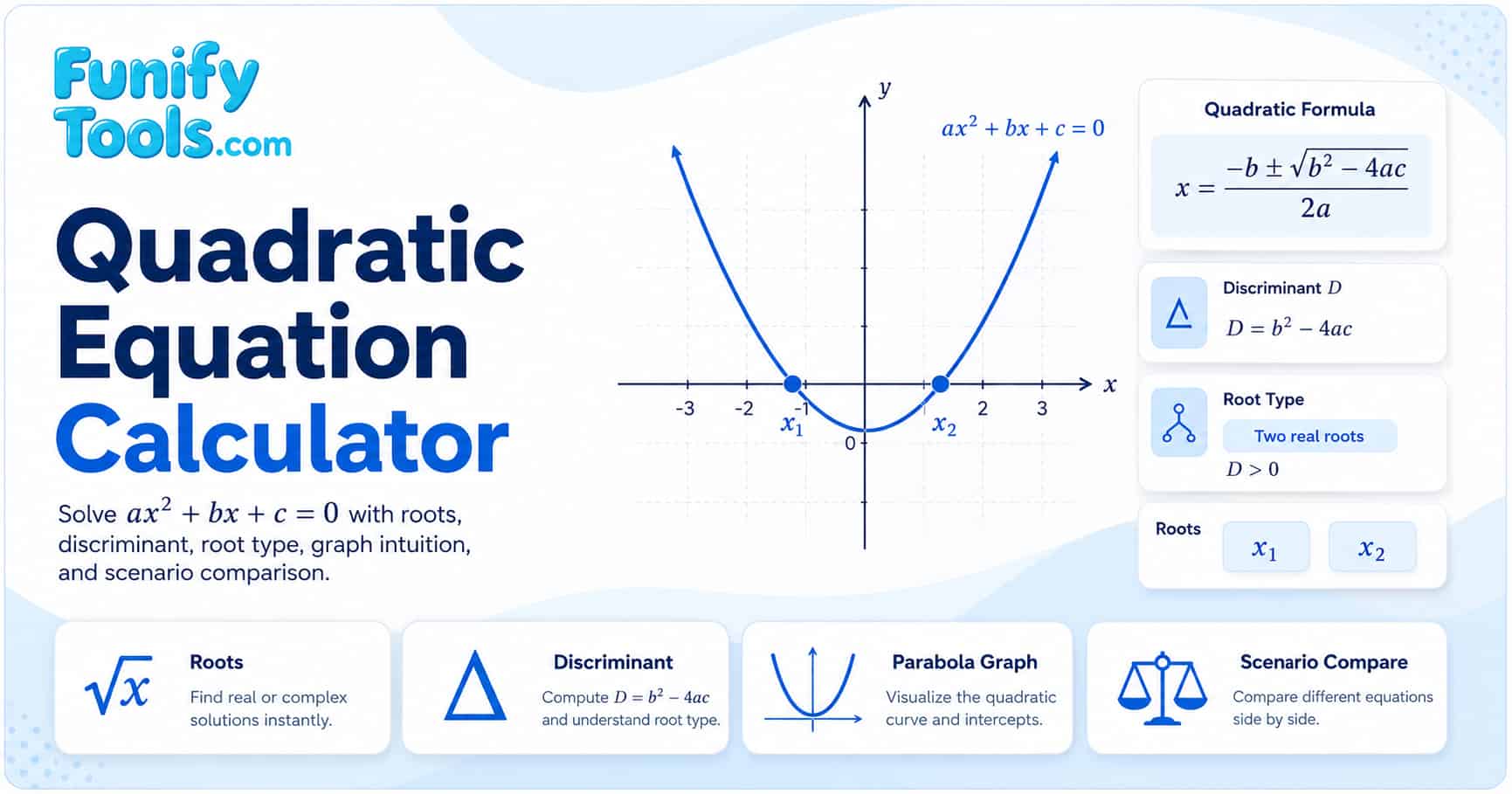
Why quadratic equations matter
A quadratic equation is any equation that can be written in the form ax^2 + bx + c = 0 with a not equal to zero. It is the simplest nonlinear polynomial equation, and because of that it appears in many places whenever a relationship has a curved response instead of a straight line. Quadratic functions are the foundation of second-degree polynomial analysis and serve as the gateway to understanding more advanced topics such as cubic equations, conic sections, and differential calculus.
In school settings, quadratic equations are often the first serious example of solving a general formula rather than a single numeric problem. Students learn to recognize patterns in coefficients, interpret the discriminant, and connect algebraic results to geometric graphs. Mastering quadratic equations builds essential problem-solving skills that carry over into SAT math, college algebra, and introductory physics courses.
In applications, they describe things like the trajectory of a ball under gravity, the cross section of some lenses and mirrors, and many basic optimization problems. Engineers use quadratic models to design suspension bridges, economists apply them to profit maximization, and computer graphics developers rely on quadratic curves for rendering smooth animations and font outlines.
The calculator on this page keeps the pattern explicit. Instead of hiding a, b, and c inside steps you cannot see, it shows how they feed the discriminant and the final roots each time you run a calculation. This transparency helps learners verify their manual work and build confidence in applying the quadratic formula independently.
If you are reviewing the concept before entering coefficients, search Google for quadratic equation standard form examples, then return here to check each example with the same a, b, and c labels.
Standard form and quadratic formula
The standard form of a quadratic equation is:
ax^2 + bx + c = 0
Here a, b, and c are real numbers, a is not zero, and x is the variable we want to solve for. By completing the square or using equivalent algebraic steps, every such equation leads to the quadratic formula. The derivation of the quadratic formula is a classic algebraic technique that begins by dividing all terms by a, moving the constant term to the right side, adding the square of half the coefficient of x to both sides, and then taking the square root.
x = (-b +/- sqrt(b^2 - 4ac)) / (2a)
D = b^2 - 4ac
The expression under the square root, b^2 - 4ac, is called the discriminant. It controls how many real solutions the equation has and whether complex roots appear. The quadratic formula works universally for any quadratic equation, making it one of the most important formulas in elementary algebra. Understanding each component of the formula helps students solve equations more accurately and interpret results meaningfully.
Discriminant and root types
The discriminant D = b^2 - 4ac summarizes the graph behavior and the number of real roots. It is a single numeric value that reveals essential information about the equation's solutions without fully solving it, which is why it is such a powerful diagnostic tool in algebra.
- D > 0: two distinct real roots, so the parabola crosses the x-axis at two points. The two roots are symmetric around the axis of symmetry x = -b / (2a).
- D = 0: one repeated real root, so the parabola just touches the x-axis at its vertex. This case is also called a double root or a perfect square trinomial.
- D < 0: no real roots, but two complex conjugate roots in the complex plane. The real part is -b / (2a) and the imaginary part is sqrt(|D|) / (2a).
The calculator displays D and labels the root type automatically so you can connect the algebra of the formula to the geometry of the graph. Recognizing the relationship between the discriminant and the parabola's position relative to the x-axis is a key skill for graphing quadratic functions without plotting every point.
| Discriminant | Root type | Graph behavior | Typical check |
|---|---|---|---|
| D > 0 | Two distinct real roots | Crosses the x-axis twice | Two different x-intercepts |
| D = 0 | One repeated real root | Touches the x-axis once | Vertex lies on the x-axis |
| D < 0 | Two complex conjugate roots | No real x-axis crossing | Parabola stays above or below the axis |
How coefficients affect the parabola
Each coefficient in ax^2 + bx + c plays a distinct role in shaping the parabola. Understanding these effects helps you predict graph behavior before plotting and interpret the meaning of each coefficient in applied problems.
| Coefficient | Effect on parabola | Mathematical role | Example behavior |
|---|---|---|---|
| a (positive) | Opens upward, wider if |a| < 1, narrower if |a|> 1 | Controls concavity and stretch | y = 0.5x^2 is wider than y = 2x^2 |
| a (negative) | Opens downward, inverted shape | Reflects across the x-axis | y = -x^2 is an upside-down parabola |
| b | Shifts the vertex horizontally | Axis of symmetry at x = -b / (2a) | y = x^2 + 4x shifts vertex left |
| c | Moves the parabola vertically | y-intercept at (0, c) | y = x^2 + 3 crosses y-axis at 3 |
When you change a single coefficient in the calculator, the generated graph updates immediately to reflect the new shape. This real-time feedback is especially helpful for visual learners who want to see how each parameter controls the curve. For deeper exploration, search Google for quadratic function coefficient effects parabola shape to find interactive demonstrations and additional explanations.
What this tool shows
To keep the interface focused, the calculator solves a single standard mode: ax^2 + bx + c = 0. For each run it records a compact set of information:
- The coefficients a, b, and c that define your equation.
- The discriminant D and the root type implied by its sign.
- Numeric approximations of the roots in decimal form.
- An exact formula view that keeps the square root expression explicit for symbolic verification.
- A generated parabola graph with the vertex and x-intercepts clearly labeled.
- A step-by-step solution that walks through the calculation in logical order.
After the calculation, you can add the scenario to the comparison table and keep a short history of recent equations on your device. The scenario comparison feature is particularly useful for homework assignments where you need to solve multiple equations and compare their discriminants, root types, and solution values side by side.
Graph intuition for ax^2 + bx + c
The graph of y = ax^2 + bx + c is a parabola. The coefficient a controls whether the curve opens upward or downward and how wide it is, while b shifts the axis of symmetry and c sets the vertical intercept. The vertex of the parabola, which represents the minimum or maximum point, is located at x = -b / (2a).
The roots of the quadratic equation correspond to the x-coordinates where the parabola crosses the horizontal axis. When D is positive, there are two crossings. When D is zero, there is exactly one touching point. When D is negative, the graph stays above or below the axis and does not cross it. The vertex y-coordinate also tells you whether the parabola reaches a minimum (a > 0) or a maximum (a < 0).
For more graph-focused practice, search Google for parabola roots vertex axis of symmetry and compare the diagrams with the generated graph in the result area.
Worked examples
Here are several equations you can try directly in the calculator. Each example illustrates a different discriminant scenario so you can see how the root type and graph behavior change with the coefficients.
- Example A, two real roots: x^2 - 5x + 6 = 0 gives D = 1, so the roots are 2 and 3. The parabola crosses the x-axis at x = 2 and x = 3.
- Example B, one repeated root: x^2 + 4x + 4 = 0 gives D = 0, so the repeated root is -2. The parabola touches the x-axis at exactly one point.
- Example C, complex roots: x^2 + 1 = 0 gives D = -4, so the roots are i and -i. The parabola stays entirely above the x-axis.
- Example D, scaled equation: 2x^2 - 10x + 12 = 0 has the same roots as x^2 - 5x + 6 = 0 because multiplying by a nonzero constant does not change the solution set.
Try entering each example into the calculator and observe how the discriminant, root type label, and graph all change consistently. This hands-on practice reinforces the theoretical concepts described throughout this guide.
Common mistakes
- Letting a be zero: if a is zero, the equation is no longer quadratic. It becomes linear, and the quadratic formula no longer applies. Always verify that the x^2 term is present.
- Dropping signs: sign errors in b or c can flip the discriminant or shift the roots, so double-check the original equation before entering it. A missing negative sign is one of the most frequent errors in algebra.
- Misreading the discriminant: only the sign of D tells you the root type. A large positive value does not automatically mean large roots. The magnitude of D affects how far apart the two real roots are, but the sign alone determines whether they are real or complex.
- Rounding too early: heavy rounding in intermediate steps can hide precision. The calculator keeps more digits internally and rounds the displayed result later, so the values you see are more reliable than hand calculations that round at each step.
Real-world uses
Quadratic equations are not just textbook examples. They appear in many practical settings across science, engineering, business, and technology.
- Projectile motion: modeling simple projectile motion in introductory physics. The height of a thrown object follows a quadratic function of time under constant gravity.
- Optimization: finding optimal points in cost, revenue, or area models. Businesses use quadratic profit functions to determine the production level that maximizes profit.
- Optics: designing lens shapes and mirror surfaces in basic optics. Parabolic mirrors focus light to a single point, which is why they are used in telescopes and satellite dishes.
- Geometry: analyzing the intersection of a circle and a line in coordinate geometry. Many geometry problems reduce to solving a quadratic equation.
- Engineering: calculating the stopping distance of a vehicle based on speed and deceleration follows a quadratic relationship.
In each case, the same quadratic formula gives the possible x values that satisfy a curved relationship. The calculator helps you explore these equations quickly so you can focus on interpretation rather than manual arithmetic. For more real-world applications, search Google for real world applications of quadratic equations examples to see how this fundamental concept appears in diverse fields.
Limits and numeric issues
The quadratic formula is exact in algebra, but numeric implementations still work within finite precision. Being aware of these limitations helps you interpret results critically and know when to double-check with symbolic methods.
| Issue | Cause | When it occurs | How to mitigate |
|---|---|---|---|
| Rounding error | Floating-point arithmetic with extreme values | Very large or very small coefficients | Use moderate coefficient values when possible |
| Subtractive cancellation | b^2 very close to 4ac reduces precision | Nearly equal roots or D near zero | Compare with exact formula view |
| Division by very small a | a close to zero amplifies rounding errors | Near-linear equations | Verify with linear methods if a is tiny |
| Higher-degree limitations | Quadratic formula only works for degree 2 | Cubic or quartic equations | Use specialized polynomial solvers |
For most educational and practical inputs with moderate sizes, the calculator provides stable results that match hand computations well. The exact formula display mode is especially helpful when you want to verify whether a small rounding difference is meaningful or just a floating-point artifact.
If you are comparing hand work with calculator output, search Google for quadratic formula step by step examples and use the displayed steps here to identify where signs, square roots, or rounding changed the answer.
References
Quadratic equation overview | Parabola basics | Discriminant in algebra