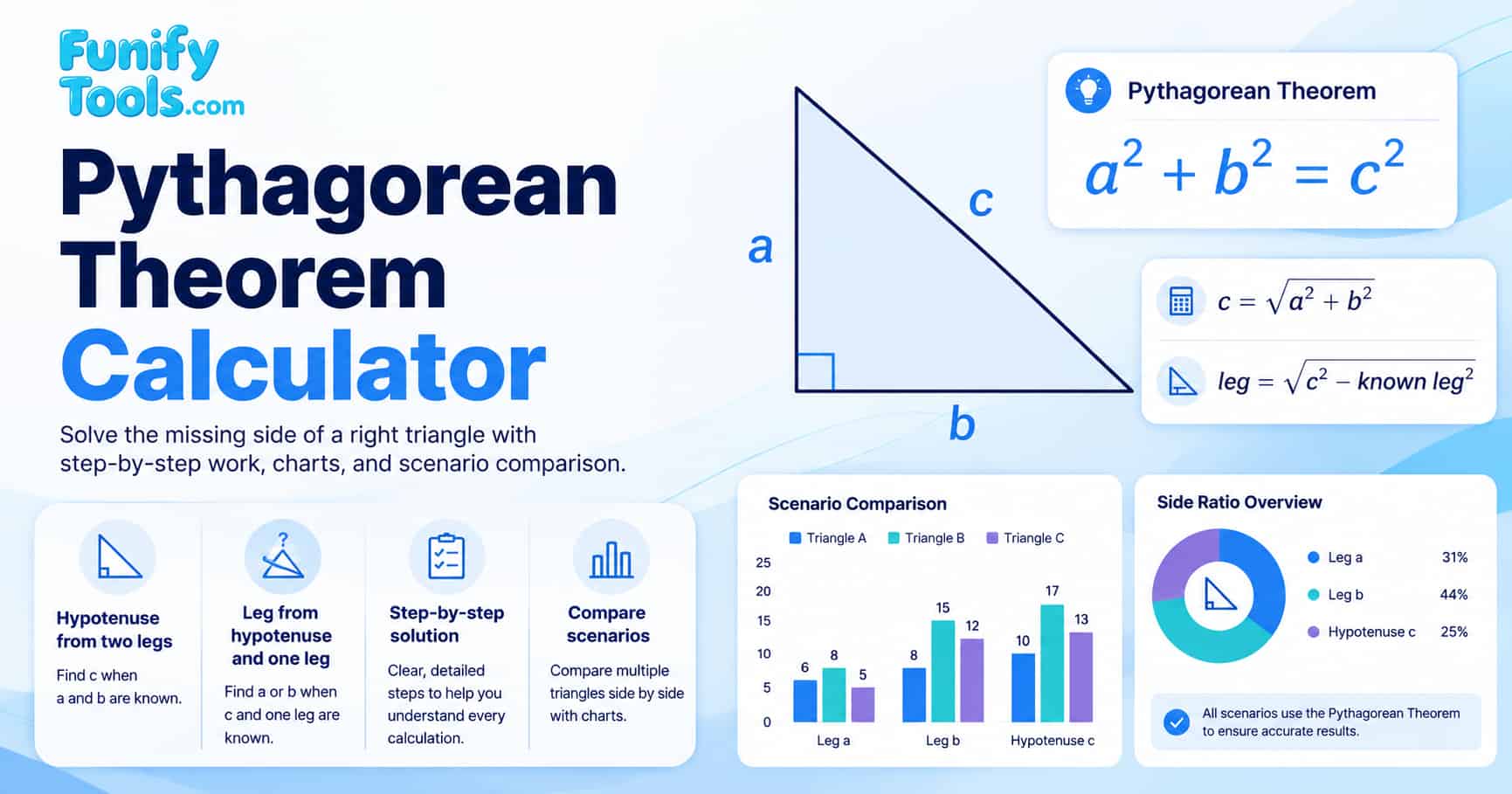
Why the Pythagorean theorem matters
The Pythagorean theorem is one of the first math relationships where a single equation describes an entire family of shapes. Any right triangle, no matter how large or small, obeys the same link between its three sides. This fundamental geometric principle, expressed as a² + b² = c², serves as the foundation for countless applications in mathematics, engineering, physics, computer graphics, and everyday problem-solving.
In practical terms, that means one formula helps you size ramps, ladders, sloped roofs, screens, supports, cables, and digital distances on a grid. If you know two sides, you do not need to guess the third or draw the triangle to scale. Architects use it to verify that building corners form perfect right angles, while carpenters rely on it daily for framing and layout work. For broader classroom explanations, review related search results for Pythagorean theorem right triangle calculator.
Core formula and rearrangements
The classic form of the theorem is written in terms of the two legs and the hypotenuse. Understanding how to rearrange the formula is essential for solving different types of problems involving right triangles.
a² + b² = c²
c = √(a² + b²)
leg = √(c² − known leg²)
Here a and b are the legs, the sides that meet at the right angle. The side c is the hypotenuse, which is opposite the right angle and is always the longest side in the triangle. The key insight is that the theorem works in two directions: you can solve for the hypotenuse when you know both legs, or solve for a missing leg when you know the hypotenuse and the other leg.
If the unknown side is the hypotenuse, take the square root of the sum of the squared legs. This is the most common use case and the one most students encounter first in geometry class.
If the unknown side is a leg, subtract the squared known leg from the squared hypotenuse, then take the square root. This variant is especially useful when you already know the longest side and need to recover one of the shorter sides.
Solve modes in this calculator
To keep things simple, the calculator offers two main solve modes. Both are based on the same theorem but differ in which side is treated as the unknown.
- Hypotenuse from two legs: enter a and b as positive lengths. The tool computes c using c = √(a² + b²).
- Leg from hypotenuse and one leg: enter a known leg and the hypotenuse c. The tool computes the missing leg using √(c² − known leg²).
When you ask for a leg, the hypotenuse must be longer than the given leg. If that condition fails, the triangle would not have real right-triangle side lengths. The calculator validates your inputs before performing any computation, ensuring you always receive accurate and meaningful results.
| Known values | Unknown side | Formula path |
|---|---|---|
| Leg a and leg b | Hypotenuse c | c = √(a² + b²) |
| Hypotenuse c and leg a | Leg b | b = √(c² − a²) |
| Hypotenuse c and leg b | Leg a | a = √(c² − b²) |
Units and scaling
The Pythagorean theorem works for any distance unit, as long as all sides use the same unit. You can enter centimeters, meters, inches, or any other consistent measure. This unit flexibility makes the theorem applicable across different fields and measurement systems worldwide.
- Length units supported: cm, m, in (inches)
- All three sides a, b, and c are reported with the same unit
- If you need another system, convert your inputs and outputs separately
If you double all lengths in a right triangle, the theorem still holds. A 3-4-5 triangle scaled up by a factor of ten becomes a 30-40-50 triangle. This scaling property is why the theorem is so powerful: once you know one valid triangle, you can generate infinitely many similar triangles by multiplying all sides by the same factor. To review common triples and scaled examples, search Google for 3 4 5 right triangle Pythagorean triples.
Geometric intuition behind the theorem
Many illustrations draw a square on each side of a right triangle. The theorem says that the area of the square on the hypotenuse is exactly equal to the sum of the areas of the two smaller squares on the legs. This visual representation helps explain why the formula uses squares of the lengths rather than the lengths themselves.
That picture explains why the formula uses squares of the lengths rather than the lengths themselves. Many proofs rely on rearranging equal areas. The geometric proof by rearrangement is one of the most intuitive: you can physically cut and rearrange the squares on the legs to perfectly fill the square on the hypotenuse, providing a visual and tactile confirmation of the algebraic relationship.
Worked examples
- Example A, 3-4-5 triangle: enter a = 3 and b = 4. The calculator computes c = √(3² + 4²) = √(25) = 5. This is the most famous Pythagorean triple.
- Example B, leg from hypotenuse 13: if c = 13 and one leg is 5, the missing leg is √(13² − 5²) = √(144) = 12. This gives another classic 5-12-13 triple.
- Example C, non-integer sides: let a = 2.7 and b = 6.1. The same formula returns a decimal hypotenuse of approximately 6.67 units.
- Example D, checking a design: a ramp that rises 0.9 meters over a 3.0 meter run has a ramp length equal to the hypotenuse, approximately 3.13 meters.
If the input values do not form a valid right triangle, the calculator shows an error message instead of returning a misleading result. This input validation is critical for educational use, as it helps students immediately identify when their assumptions about a triangle are incorrect.
Common mistakes to avoid
- Using the wrong side as the hypotenuse: the hypotenuse is always opposite the right angle and is always the longest side. In any right triangle, the hypotenuse is never one of the legs.
- Forgetting to square the sides: the theorem uses a² + b², not a + b. A common error is adding the side lengths directly without squaring them first.
- Mixing units: convert all sides to the same unit before calculating. For example, if one side is in meters and another in centimeters, convert everything to the same unit first.
- Using it on non-right triangles: the theorem requires a 90-degree angle. For acute or obtuse triangles, the law of cosines or law of sines must be used instead.
- Rounding too early: keep extra precision until the final step when doing hand calculations. Premature rounding can introduce significant errors in the final result.
History and proofs at a high level
The relationship between the sides of right triangles was known long before it carried the name of Pythagoras. Ancient sources suggest versions of the theorem were used in Babylonian mathematics as early as 1900 BCE for surveying and construction. Egyptian surveyors, or "rope stretchers," used a rope with 12 equally spaced knots to form a 3-4-5 right triangle for marking out right angles in fields and building foundations.
The theorem is traditionally associated with the Greek mathematician Pythagoras because his school studied it in a more systematic and symbolic way around the 6th century BCE. Many proofs have been discovered over the centuries, including geometric rearrangements, algebraic arguments, and approaches based on similar triangles. In fact, the Pythagorean theorem is often described as one of the most-proved results in mathematics, with hundreds of distinct proofs documented in books, records, and educational collections. For more about the historical development of geometry, search Google for the history of the Pythagorean theorem in ancient mathematics.
Real-world uses beyond homework
- Estimating ladder or support lengths needed to reach a height from a safe distance. For example, if a ladder needs to reach a window 4 meters high and must be placed 1.5 meters from the wall, the ladder length is the hypotenuse.
- Checking that a floor plan corner is square by comparing measured diagonals. In construction, this is known as "squaring" a layout and is essential for accurate framing.
- Computing screen diagonals from width and height. TV and monitor sizes are reported as diagonal measurements, which are calculated using the Pythagorean theorem.
- Finding shortest paths in grid-like layouts such as streets or pixel coordinates. This application is fundamental to GPS navigation and computer graphics rendering.
- Relating horizontal and vertical movement in basic physics problems, such as calculating the resultant force vector from two perpendicular forces.
Pythagorean triple reference table
A Pythagorean triple is a set of three positive integers that satisfy the Pythagorean theorem. These triples represent right triangles with whole-number side lengths and are useful for quick mental calculations and classroom demonstrations. Below are some of the most common and useful Pythagorean triples.
| Leg a | Leg b | Hypotenuse c | Primitive? | Common uses |
|---|---|---|---|---|
| 3 | 4 | 5 | Yes | Most famous triple, basic geometry |
| 5 | 12 | 13 | Yes | Roof framing, ladder problems |
| 6 | 8 | 10 | No (3-4-5 × 2) | Scale model of 3-4-5 |
| 7 | 24 | 25 | Yes | Surveying applications |
| 8 | 15 | 17 | Yes | Construction layout |
| 9 | 12 | 15 | No (3-4-5 × 3) | Larger scale models |
| 9 | 40 | 41 | Yes | Advanced geometry problems |
| 12 | 16 | 20 | No (3-4-5 × 4) | Framing and carpentry |
| 15 | 20 | 25 | No (3-4-5 × 5) | Land measurement |
| 20 | 21 | 29 | Yes | Engineering calculations |
Limits and extensions of the theorem
The Pythagorean theorem is powerful but not universal. It is tied to flat, Euclidean geometry and to triangles with one right angle. Understanding its limitations is just as important as knowing how to apply it.
- On curved surfaces such as a sphere, distances do not follow the same rule. For example, on Earth's surface, great-circle distance calculations require spherical geometry, not the Pythagorean theorem.
- For acute or obtuse triangles, you need the law of cosines, which includes the angle between the known sides. The law of cosines generalizes the Pythagorean theorem to all triangles.
- Measurement errors in the sides can propagate into the result, so precise work requires careful input checks. The calculator handles this by letting you specify values with up to four decimal places.
In coordinate geometry, the distance between two points is computed using a version of the same formula, where differences in x and y act as the legs of an invisible right triangle. This extension, known as the distance formula, is a cornerstone of analytic geometry and appears in everything from computer graphics to machine learning algorithms. For that connection, Google results for distance formula from Pythagorean theorem are a useful next step.
Final notes
- The Pythagorean theorem links the squares of all three sides of a right triangle with the formula a² + b² = c².
- The hypotenuse is always longer than either leg and sits opposite the right angle.
- The same formula works for any consistent length unit, making it universally applicable across measurement systems.
- The calculator highlights the formula used and a step-by-step path for complete transparency in every calculation.
- Scenario comparison and Funify Notes help with homework, notes, and design checks across multiple scenarios.
References
Pythagorean theorem overview | Right triangle basics | Distance in geometry | Pythagorean triple list | Law of cosines