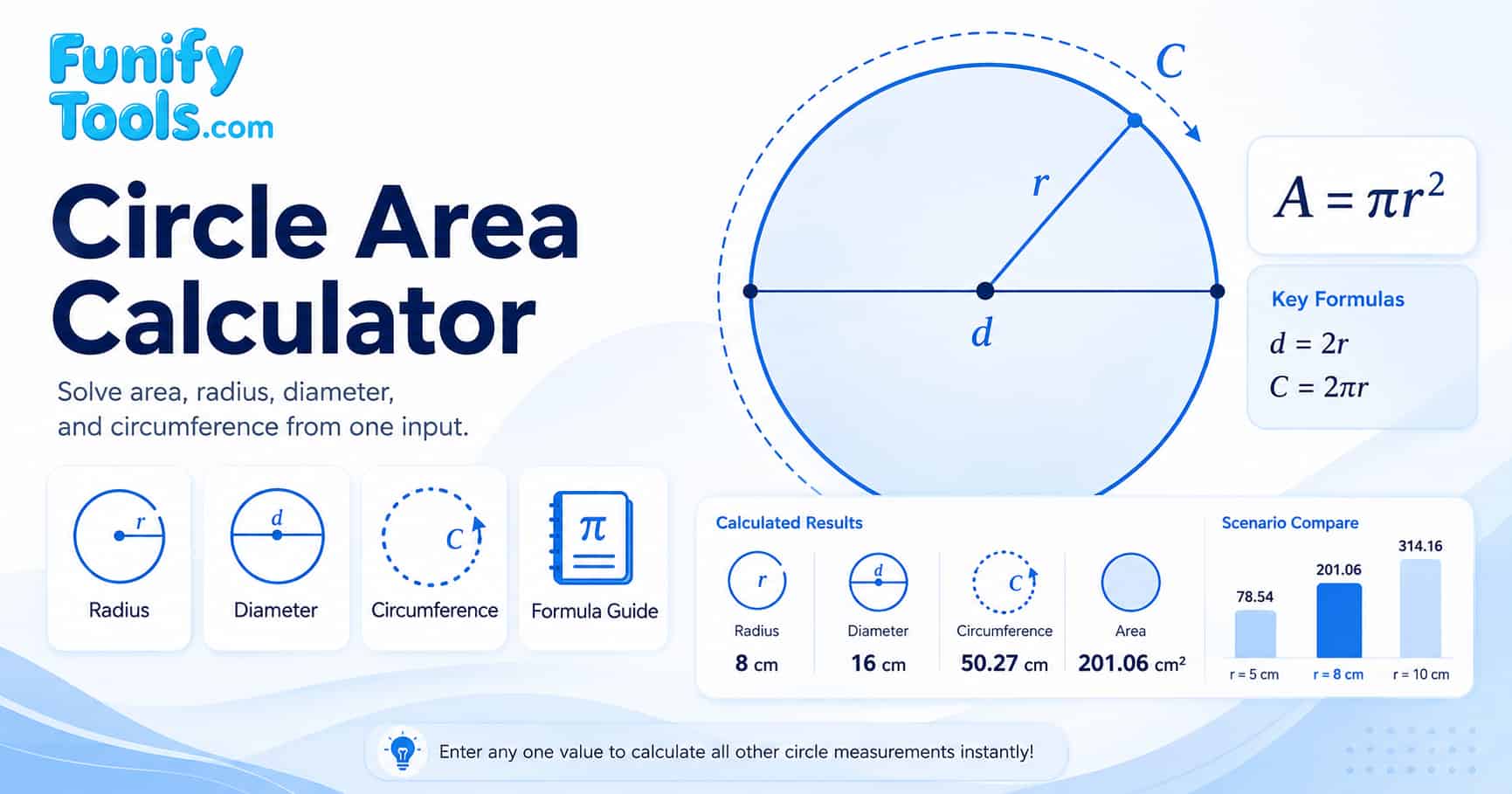
Why circle formulas matter
The circle is one of the first shapes where a single measurement unlocks everything else. If you know radius, you can get area and circumference right away. If you only know area, you can reverse the formula and still recover radius and diameter. Mastering these relationships is essential for students studying geometry, professionals working in engineering and design, and anyone who needs to estimate material quantities for round objects.
In practice, circles are used for wheels, pipes, lids, round tables, sports courts, signs, garden beds, and any curved opening. Area helps you estimate materials, coverage, paint, fabric, flooring, or capacity. Circumference helps you estimate edge length, trim, sealing needs, or travel distance per rotation. Understanding how radius, diameter, area, and circumference relate to one another gives you the ability to solve a wide range of practical problems without memorizing every formula individually.
This calculator keeps the formulas consistent, so you can focus on your problem instead of rearranging algebra each time. For a quick broader search, see Google results for circle area formula pi r squared to explore additional explanations and visual tutorials from educational sites.
Core formulas
All results come from these standard relationships that have been used in mathematics for thousands of years:
Area = pi x r^2
Diameter = 2 x r
Circumference = 2 x pi x r
Here, r means radius, the distance from the center to the edge. Pi (π) is a mathematical constant approximately equal to 3.14159. The tool uses a high precision value internally, then rounds for display. These three formulas are all you need to derive any circle measurement from any other single measurement.
If you start from diameter, the tool first converts to radius by dividing by 2. If you start from area, it rearranges the formula this way:
r = sqrt(Area / pi)
After radius is known, diameter and circumference are direct. If you want to compare textbook explanations, this Google search for radius diameter circumference relationship is a useful starting point for seeing how different educational resources present the same material.
Formula comparison table
This table summarizes every formula the calculator uses, including the reverse operations. Use it as a quick reference when solving circle problems by hand or verifying calculator results.
| Known value | Target value | Formula | Example (r = 5 cm) |
|---|---|---|---|
| Radius (r) | Area (A) | A = π × r² | 78.54 cm² |
| Radius (r) | Diameter (d) | d = 2 × r | 10 cm |
| Radius (r) | Circumference (C) | C = 2 × π × r | 31.42 cm |
| Diameter (d) | Area (A) | A = π × (d ÷ 2)² | 78.54 cm² |
| Diameter (d) | Radius (r) | r = d ÷ 2 | 5 cm |
| Area (A) | Radius (r) | r = √(A ÷ π) | 5 cm |
| Area (A) | Diameter (d) | d = 2 × √(A ÷ π) | 10 cm |
| Area (A) | Circumference (C) | C = 2 × π × √(A ÷ π) | 31.42 cm |
Notice how every formula ultimately depends on the radius. This is why the calculator always solves for radius first, no matter which value you start from. The relationship is symmetrical: as long as you have one correct measurement, you can derive all the others.
Units and conversions
Pick one length unit and stay consistent. If you enter radius in cm, diameter and circumference will also be in cm. Area will be in cm² because area is always squared length. This consistency is critical: mixing units is one of the most common sources of error in circle calculations.
The calculator does not change your units behind the scenes. It assumes your input already uses the unit you select, then keeps outputs in that same unit system. If you need to convert between metric and imperial systems, you must do that before entering your value.
- Length units: cm, m, in (inches)
- Area units: cm², m², in²
If you need to convert area between systems, convert length first, then square it. For example, 1 m = 100 cm, so 1 m² = 10,000 cm². This is why a small length conversion error can create a much larger area error. Always double-check your unit selection before running the calculation.
Examples
These examples walk through the three possible solve modes so you can see exactly how the calculator works in each case. Each example starts from a different known value and derives the full set of circle measurements.
- Example A, radius 5 cm: Area = π × 5² = π × 25, approximately 78.54 cm². Diameter = 10 cm. Circumference is approximately 31.42 cm. This is the most straightforward case because radius is the direct input for the area formula.
- Example B, diameter 12 in: Radius = 6 in. Area = π × 6² = π × 36, approximately 113.10 in². Circumference is approximately 37.70 in. Notice how the diameter must be halved before the area formula can be applied.
- Example C, area 200 m²: Radius = √(200 ÷ π), approximately 7.98 m. Diameter is approximately 15.96 m. Circumference is approximately 50.12 m. This is the reverse case: the calculator recovers radius from area, then derives everything else.
Notice how only one value changes the whole circle. That is why circles are so convenient in design work, estimating projects, and checking geometry homework. For more worked problems, try a Google search for how to find area of a circle examples to see step-by-step walkthroughs from math education websites.
Common mistakes
Even experienced students and professionals can make errors when working with circle formulas. Being aware of these common pitfalls will help you avoid them and get accurate results every time.
- Using diameter in the area formula: Area needs radius. If you have diameter, halve it first. The formula A = π × d² gives a result that is four times larger than the correct area.
- Forgetting the square: r² means radius times radius, not radius times 2. Confusing r² with 2r is one of the most frequent algebra mistakes in geometry.
- Mixing units: if radius is cm but area is treated like m², results will be wrong by large factors. Always verify that your input unit matches the unit you intend to use.
- Rounding too early: keep extra decimals until the final step if you are doing it by hand. Rounding π to 3.14 instead of 3.14159 can introduce noticeable errors in larger circles.
- Confusing radius and diameter: always confirm whether a given measurement is the distance from center to edge (radius) or the full width (diameter).
The tool avoids these by doing the order correctly and only rounding in the final display. The generated circle diagram also helps you see whether your input is being interpreted as radius, diameter, or area, giving you a visual check before you use the results.
Real-world uses
Circles are not just classroom shapes. Area and circumference show up in countless everyday and professional scenarios:
- Floor planning for round tables or stages
- Pipe cross section sizing for flow capacity
- Wheel travel distance per rotation
- Pizza, cake, and lid coverage comparisons
- Garden bed sizing and irrigation reach
- Round rug and carpet measurement for room layouts
- Circular pool volume estimation for water treatment
If you ever wondered how much bigger a 14 inch pizza is than a 12 inch pizza, that is a circle area problem: area grows with the square of radius, so visual size and usable surface can increase faster than the diameter number suggests. A 14 inch pizza has about 36% more area than a 12 inch pizza, even though the diameter is only about 17% larger.
Unit conversion table
When working with circle measurements, you may need to convert between different unit systems. This table provides the most common length conversions needed for circle calculations. Use it to convert your input values before entering them into the calculator.
| From unit | To unit | Conversion factor | Example |
|---|---|---|---|
| Inches (in) | Centimeters (cm) | 1 in = 2.54 cm | 12 in = 30.48 cm |
| Centimeters (cm) | Inches (in) | 1 cm = 0.3937 in | 30 cm = 11.81 in |
| Meters (m) | Centimeters (cm) | 1 m = 100 cm | 2 m = 200 cm |
| Centimeters (cm) | Meters (m) | 1 cm = 0.01 m | 150 cm = 1.5 m |
| Inches (in) | Meters (m) | 1 in = 0.0254 m | 36 in = 0.9144 m |
| Meters (m) | Inches (in) | 1 m = 39.37 in | 0.5 m = 19.69 in |
Remember that area units follow the square of the length conversion factor. For example, since 1 m = 100 cm, 1 m² = 10,000 cm². Always convert length values first, then apply the circle formulas for area.
Area scaling table
This table shows how area changes as radius increases. Understanding this scaling behavior is essential for estimating how much larger one circle is compared to another. The relationship is quadratic: doubling the radius quadruples the area.
| Radius | Diameter | Area | Circumference | Area increase vs r = 1 |
|---|---|---|---|---|
| 1 cm | 2 cm | 3.14 cm² | 6.28 cm | 1× (baseline) |
| 2 cm | 4 cm | 12.57 cm² | 12.57 cm | 4× |
| 3 cm | 6 cm | 28.27 cm² | 18.85 cm | 9× |
| 4 cm | 8 cm | 50.27 cm² | 25.13 cm | 16× |
| 5 cm | 10 cm | 78.54 cm² | 31.42 cm | 25× |
| 10 cm | 20 cm | 314.16 cm² | 62.83 cm | 100× |
Notice that when radius grows from 1 cm to 10 cm (10× increase), the area grows from 3.14 cm² to 314.16 cm² (100× increase). This quadratic relationship is why small changes in radius produce disproportionately large changes in area. Keep this in mind when comparing circle sizes for practical applications like material estimation or cost comparison.
References
Wikipedia: Circle | Wikipedia: Area of a circle | Wikipedia: Circumference