What recipe scaling is
Recipe scaling is the process of adjusting ingredient quantities so that a dish yields a different number of servings than the original recipe intended. Most recipes are written for a specific yield such as 2 bowls of soup, 12 cookies, a 9-inch cake, or 4 portions of pasta. Scaling preserves the proportional balance of flavors, textures, and cooking chemistry while changing the total batch size. This is why a reliable recipe scaler is essential for home cooks, meal preppers, caterers, and bakers who regularly adapt recipes for different group sizes.
Scaling is especially valuable when you are meal prepping for the week, adapting a recipe to fit your available cookware, matching nutritional targets for dietary goals, or reducing leftovers to minimize food waste. It also helps you plan shopping lists accurately because you can resize a dish before buying ingredients instead of estimating at the store and risking surplus or shortage. For more on how professional kitchens handle batch adjustments, search Google for professional recipe scaling techniques for batch cooking to see industry methods.
For a broader understanding of how portion adjustment works in everyday cooking, search Google for how to scale a recipe servings to compare common kitchen approaches, then use this calculator to apply the exact factor to your own ingredient list.
Scaling formula
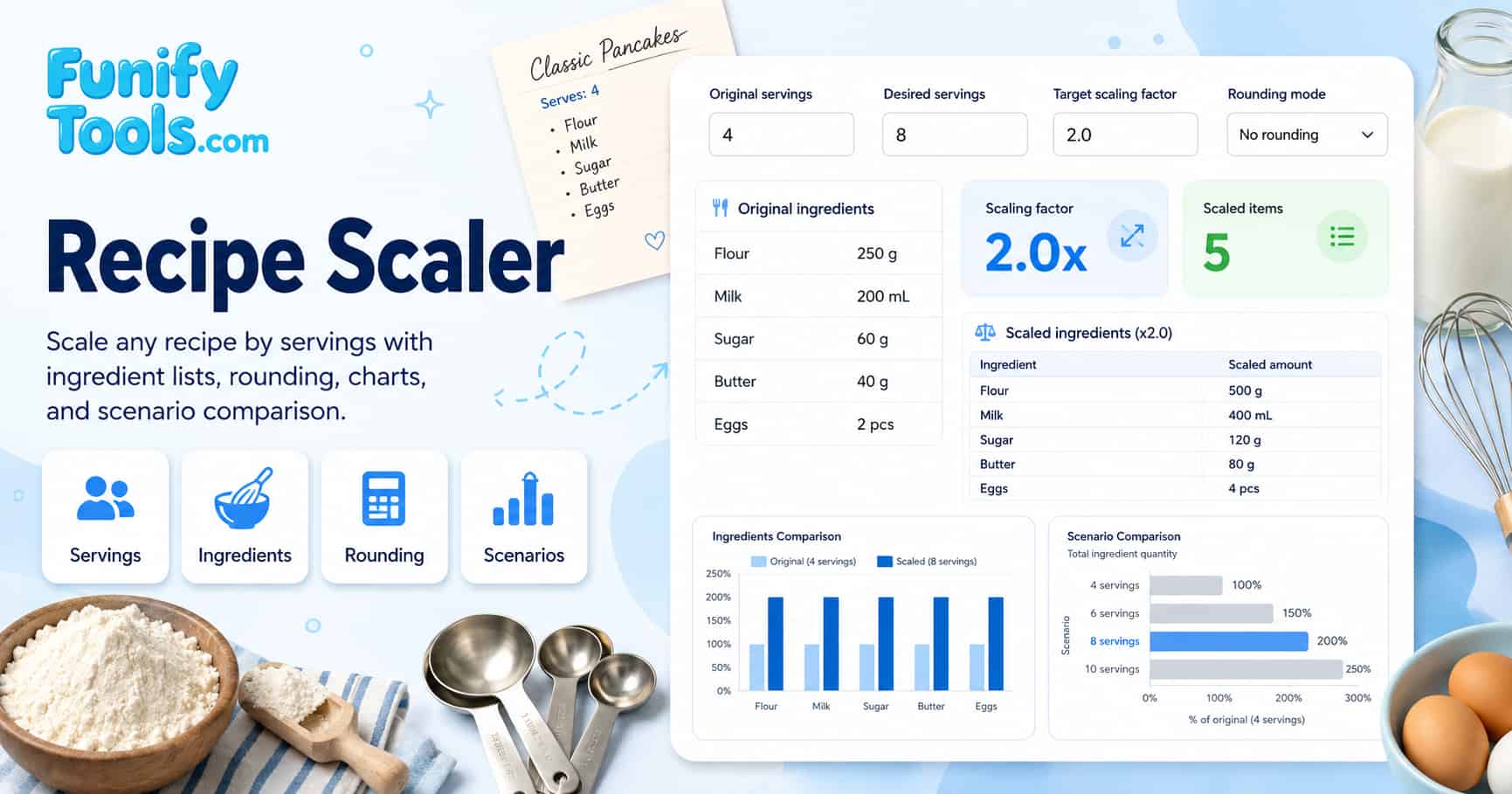
The scaling factor is calculated as desired servings divided by original servings. Each ingredient amount is then multiplied by this factor. For example, if a recipe makes 4 servings and you need 8, the factor is 8 ÷ 4 = 2.0, meaning every ingredient is doubled.
The tool also supports an optional target factor input. If you know you want to grow the recipe by a specific multiplier such as 1.5x to match a particular pan size or package quantity, you can enter that target and see how close your serving-based factor aligns. This dual-input approach gives you flexibility when resizing a recipe to match a pan, a bulk ingredient package, or a planned headcount.
For small-batch scaling, remember that the formula is only the first step. Half an egg, a tiny pinch of yeast, or a few grams of salt may require a practical measuring decision after the calculator provides the exact number. In those cases, rounding sensibly and tasting as you go is the best strategy.
Scaling factor reference table
The table below shows common serving conversions and their corresponding scaling factors. Use it as a quick reference to estimate how much to multiply your ingredients before entering values into the calculator.
| Original servings | Desired servings | Scaling factor | Example use case |
|---|---|---|---|
| 2 | 4 | 2.00 | Date night to family dinner |
| 4 | 6 | 1.50 | Family meal with one extra guest |
| 4 | 8 | 2.00 | Standard dinner to party batch |
| 6 | 12 | 2.00 | Small gathering to larger event |
| 8 | 4 | 0.50 | Halving a large recipe |
| 12 | 6 | 0.50 | Batch cooking to single meal |
| 4 | 10 | 2.50 | Family meal to party platter |
| 6 | 9 | 1.50 | Adding a few extra portions |
Keep in mind that these factors are mathematical starting points. Ingredients with strong flavors or structural roles may need manual adjustment, especially at extreme factors above 3.0 or below 0.33.
Units and consistency
Scaling works best when the units used for each ingredient remain consistent throughout the process. If the original recipe uses cups, tablespoons, and grams together, scaling is still valid because each ingredient is multiplied within its own unit. When units are mixed, this calculator groups totals and averages by unit instead of adding unrelated units into one combined amount.
The charts follow the same rule. When ingredient types have practical adjustment guidance, the charts compare the exact linear scaling factor with a suggested starting factor. With mixed units and no adjustment guidance, chart axes switch to x-factor scaling so large-number units such as liters do not visually overwhelm small-number units such as teaspoons. When every ingredient uses the same unit and no adjustment is needed, the first chart can show the largest ingredient share because the total has a meaningful unit.
If you need higher precision, consider converting key ingredients to grams before scaling. Dry goods such as all-purpose flour, bread flour, granulated sugar, and brown sugar benefit most from weight-based measurement because their density varies significantly with sifting, settling, and packing method. Dense liquids like oils, honey, and molasses also scale more reliably by weight. A cup of chopped herbs, a cup of flour, and a cup of oil do not represent the same mass, so weight becomes increasingly important as the batch size grows.
When a recipe mixes volume and weight units, keep the original unit visible in your notes or ingredient list. Scale each line first using the calculator, then decide whether any line should be converted to a more practical unit for shopping or measuring. For example, 2.37 tablespoons of olive oil might be easier to measure as 35 ml or 32 g depending on your kitchen tools.
Rounding strategy
Scaled amounts often land on awkward numbers such as 2.37 tablespoons of vinegar or 63.4 grams of butter. The calculator offers three rounding modes: no rounding for precision baking and laboratory-style accuracy, half-step rounding (to 0.5 increments) for spoon measures like teaspoons and tablespoons, and whole-step rounding for forgiving ingredients where exact measurement is less critical.
A smart practical approach is to round minor ingredients such as dried herbs, spices, and extracts first while keeping major structural ingredients like flour, water, eggs, and butter closer to the computed value. For baking, keep rounding as tight as possible because chemical leavening and hydration ratios are sensitive. For soups, stews, salads, and sauces, taste and texture provide enough feedback that rounding to convenient measures is safe.
For more background on practical kitchen measurement techniques, search Google for recipe measurement conversions grams cups before converting ingredients that vary significantly by density, such as flour, cocoa powder, chopped nuts, shredded cheese, or grated coconut.
Baking-specific guidance
Baking is less tolerant of scaling errors than savory cooking because the structure of baked goods depends on precise ratios between flour, fat, liquid, sugar, and leavening. While these core ingredients scale linearly in theory, oven behavior also depends on pan size, batter depth, and heat circulation. Always check pan geometry and adjust baking time in small increments of 3 to 5 minutes rather than applying the scaling factor to time.
For bread and pizza dough, hydration percentage is critical. If a dough formula specifies 65 percent hydration, scaling is safe because flour and water increase together proportionally. However, flour absorbs moisture differently by brand, season, and protein level, so the final dough feel and windowpane test matter more than the math. For artisan bread bakers, search Google for baker percentage hydration scaling guide to learn how professional bakers maintain consistent dough properties across batch sizes.
When scaling cakes, brownies, and quick breads, pan area often matters more than serving count alone. A larger pan with the same batter depth bakes differently from a deeper pan with the same area. Use the calculator for ingredient amounts, then check pan area and doneness cues such as a clean toothpick, spring-back, or internal temperature separately.
Spices and leavening
Spices, salts, and aromatics often do not need perfect linear scaling because flavor perception is not purely additive. When scaling up, taste can saturate or become harsh if spices are doubled exactly. A good rule of thumb is to scale spices linearly up to about 1.5x to 2x, then add gradually while tasting the dish during the final stages of cooking.
Leavening agents such as baking powder, baking soda, and yeast can fail at extreme scales. Too much leavening can cause a batter to rise rapidly then collapse, or leave a bitter chemical aftertaste. Too little leavening can make cakes dense, muffins heavy, or bread fermentation sluggish, especially when batch size and ambient temperature both change. When scaling yeast doughs beyond 3x, consider using preferments or adjusting fermentation time rather than multiplying yeast linearly.
Salt deserves special attention in any scaled recipe. A mathematically correct scaled amount may be perfect for dough, brine, or dry rub, but sauces, braises, and soups should always be tasted near the end of cooking because evaporation concentrates salt as liquid reduces. It is safer to undersalt slightly during scaling and adjust at the table or during final seasoning. For more on how salt concentration changes during cooking, search Google for how salt concentration changes during cooking evaporation to understand the science behind seasoning adjustments.
The suggested starting amounts in this calculator are not official standards. They are conservative heuristics for sensitive categories such as salt, spices, leavening, aromatics, and thickeners. Use the linear scaled amount as the mathematical result, then use the suggested amount as a practical first pour, pinch, or addition before tasting and adjusting.
Ingredient scaling adjustment table
Different ingredient categories behave differently when scaled. The table below summarizes how each type responds to scaling and how the calculator treats its suggested starting amount. These curves are intentionally conservative and are best read as tasting guidance, not standardized recipe science.
| Ingredient category | Examples | Scaling behavior | Recommended adjustment |
|---|---|---|---|
| Structural dry goods | Flour, cornstarch, oats, breadcrumbs | Scales linearly with high accuracy | Suggested amount stays at 100% of linear |
| Liquids & dairy | Water, milk, broth, cream, oil | Scales linearly; evaporation may concentrate flavor | Suggested amount stays at 100% of linear |
| Eggs | Whole eggs, egg whites, yolks | Linear but fractional eggs need practical handling | Suggested amount stays linear; handle fractions manually |
| Leavening agents | Baking powder, baking soda, yeast | Linear at small scales; risky above 3x | Suggested start tapers down at larger factors |
| Spices & dried herbs | Cinnamon, cumin, oregano, paprika | Linear in math but flavor saturates | Suggested start is conservative above 1x |
| Salt & savory seasonings | Table salt, soy sauce, fish sauce, miso | Linear but concentration changes with reduction | Suggested start is below linear, then taste-adjust |
| Fresh aromatics | Garlic, ginger, onion, shallots, chilies | Linear; intensity varies by freshness and size | Suggested start is slightly below linear at larger factors |
| Thickening agents | Gelatin, agar, cornstarch slurry, roux | Linear in theory; texture can shift at extremes | Suggested start is slightly below linear; add more if needed |
Use this table as a reference when reviewing the calculator output. Ingredients in the top rows can usually be taken at face value, while those in the bottom rows benefit from a cautious approach and manual tasting.
Equipment and time
Scaling changes the total volume of food, which in turn changes heat flow dynamics. A larger pot of soup takes longer to reach a simmer. A larger roast needs more time to cook through, but not in direct proportion to weight. As a general guideline, if you double a stew you might add 20 to 40 percent extra cooking time rather than 100 percent. Always use a thermometer to check doneness rather than relying on time alone.
Also verify your cookware capacity before cooking. If you scaled a recipe to 2x but your largest pot or mixing bowl is only 1.3x larger, split the batch into two cooking vessels. Crowding a sheet pan can cause food to steam instead of brown, and overfilling a saucepan makes stirring difficult and simmering uneven. For roasting, ensure there is adequate airflow around each piece for even browning.
For oven-based projects where pan size directly affects results, search Google for pan size conversion recipe scaling when your serving count and pan geometry point to different multipliers. This is especially common when adapting cake recipes to different pan shapes or scaling sheet pan dinners.
Pan size conversion table
When scaling baked goods, the pan you use can be just as important as the ingredient amounts. The table below shows common pan sizes, their surface areas, and the area ratio relative to an 8-inch square pan, which is a frequent baseline in home baking recipes.
| Pan shape & size | Approximate area (sq in) | Area ratio vs 8″ square | Best for |
|---|---|---|---|
| 8″ × 8″ square | 64 | 1.00 | Brownies, bar cookies, cornbread |
| 9″ × 9″ square | 81 | 1.27 | Larger brownies, cake squares |
| 9″ × 13″ rectangle | 117 | 1.83 | Sheet cakes, lasagna, casseroles |
| 9″ round | 64 | 1.00 | Standard layer cakes, deep-dish pizza |
| 10″ round | 79 | 1.23 | Larger round cakes, quiche |
| 12″ round | 113 | 1.77 | Party-size cakes, deep-dish pies |
| 9″ × 5″ loaf | 45 | 0.70 | Quick breads, pound cakes, meatloaf |
| Half sheet (13″ × 18″) | 234 | 3.66 | Large batch cookies, sheet cakes |
To use this table, find your original pan and your target pan, then multiply your ingredients by the ratio of the target area divided by the original area. If the area ratio and serving-based factor differ by more than 20 percent, prioritize the area ratio for baking and the serving factor for stovetop dishes.
Worked examples
Example 1. Pancakes for more people. Original recipe: 2 servings, flour 120 g, milk 200 ml, eggs 1, sugar 10 g, butter 15 g. Desired: 5 servings. Scaling factor is 5 ÷ 2 = 2.5. Scaled amounts: flour 300 g, milk 500 ml, eggs 2.5 (beat one egg and use half by weight), sugar 25 g, butter 37.5 g. The batter volume increases noticeably, so use a larger griddle or cook in batches.
Example 2. Soup for fewer bowls. Original recipe: 6 servings, chicken 600 g, carrots 300 g, broth 1.5 liters, salt 10 g. Desired: 3 servings. Factor is 0.5. Scaled: chicken 300 g, carrots 150 g, broth 0.75 liters, salt 5 g. Use a smaller pot to maintain proper simmer depth, and taste the salt near the end because reduced evaporation may leave it slightly stronger.
Example 3. Sauce for a party. Original: 4 servings, tomato sauce 500 ml, olive oil 30 ml, garlic 2 cloves, basil 8 g. Desired: 10 servings. Factor is 2.5. The sauce becomes 1,250 ml tomato sauce, 75 ml olive oil, 5 cloves garlic, and 20 g basil. You might start with 4 cloves of garlic and adjust upward because garlic intensity varies by freshness and variety.
Case study
You want to scale brownies from an 8-inch square pan to a 9 by 13 pan. The area ratio is about 117 ÷ 64 = 1.83. If the original recipe makes 9 pieces and you want 16 pieces for the larger pan, the serving-based factor is 16 ÷ 9 = 1.78. These two methods are close, so a factor around 1.8 works well for both ingredients and baking time. Start checking for doneness at the original time plus 5 minutes.
If the factor from servings and the factor from pan area are far apart, decide which result matters more for the dish. For brownies, pan area and batter depth are critical for even baking. For soup, serving count usually matters more than pot diameter. For cookies, the number of pieces and scoop size often matter more than tray area, so you can scale by servings and spread the dough across multiple trays.
Common pitfalls
- Forgetting to scale oils, dressings, and sauces because they are added late in the cooking process.
- Over-scaling salt, hot spices, and concentrated seasonings without tasting the dish during cooking.
- Assuming cook time scales linearly with batch size when heat transfer physics works differently.
- Using packed cups for flour, then scaling those values as if they were precise weight measurements.
- Not adjusting pan size or splitting batches when volume changes significantly in baking.
- Rounding every ingredient the same way instead of treating structural ingredients like flour and water more carefully than spices and garnishes.
- Ignoring evaporation effects in long-simmered dishes where liquid reduces and flavors concentrate.
Assumptions and what is not included
- The calculator performs proportional scaling only and does not adjust for ingredient interactions.
- Suggested starting amounts are practical heuristics and are not standardized culinary formulas.
- No automatic unit conversions are performed across ingredients with different measurement systems.
- Mixed-unit totals and averages are grouped by unit; no grams, cups, and milliliters are added into one total.
- Adjustment charts compare linear scaling with suggested starting x-factors; mixed-unit charts avoid raw amount comparisons.
- Accuracy depends on the quality of your original recipe and the precision of your measuring method.
- Cooking time, pan geometry, evaporation rates, and taste adjustments must be reviewed separately by the cook.
- The tool does not account for altitude, humidity, or ingredient brand variations that may affect results.
References
Wikipedia Recipe | Cooking weights and measures | Baker percentage