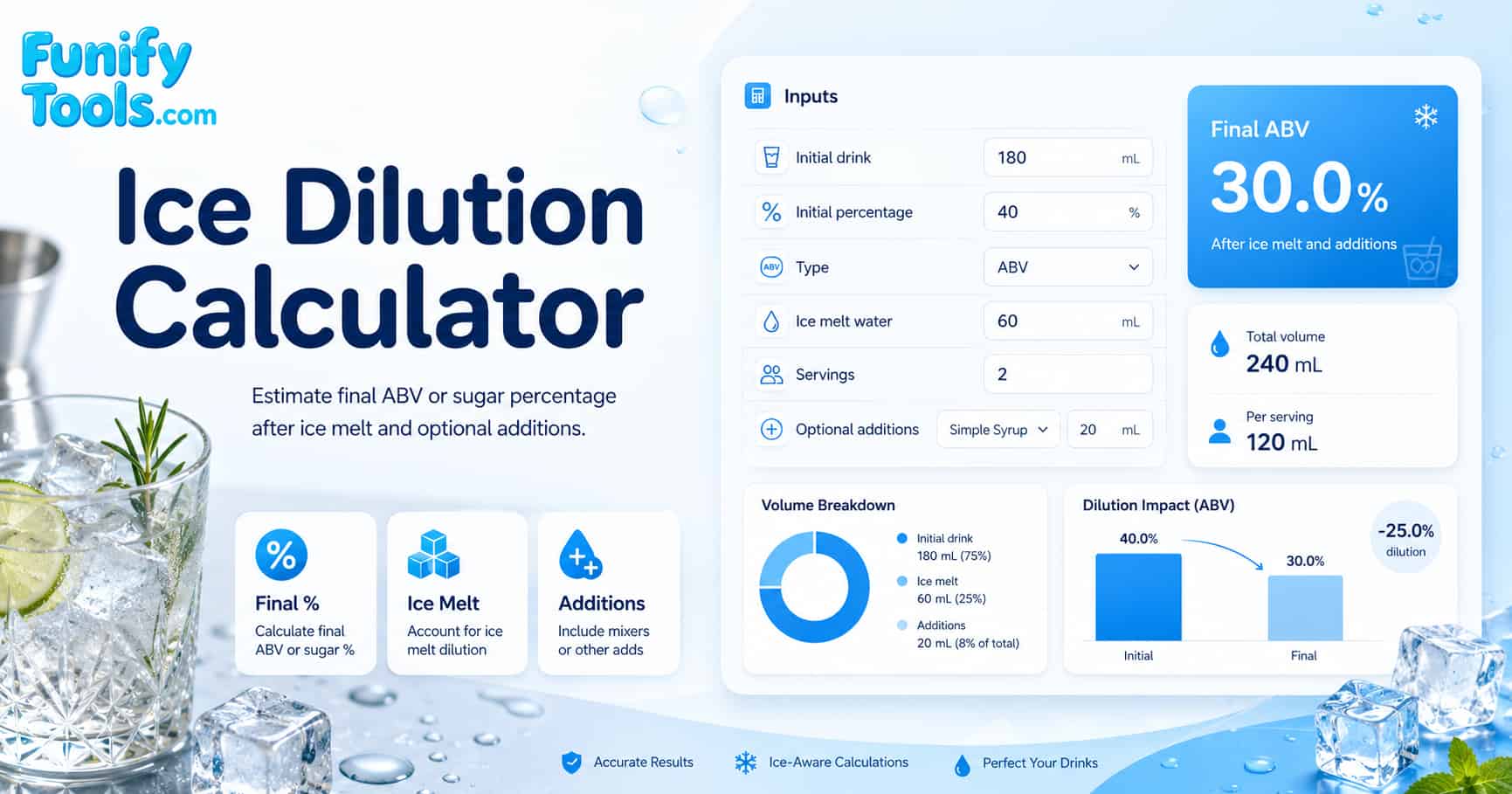
Why dilution matters
Ice cube dilution is one of the quiet variables that decides whether a drink tastes sharp, smooth, watery, strong, sweet, or balanced. As ice melts, it adds water to the drink. That extra water lowers ABV, lowers sugar percentage, increases total volume, changes texture, and changes how aroma, acidity, bitterness, and sweetness show up on the palate. A drink that tastes intense before chilling can become balanced after the right amount of dilution. Understanding how ice dilution affects cocktail ABV is essential for anyone who wants consistent results from their home bar or professional cocktail program.
An ice dilution calculator is useful because melt water is easy to underestimate. A shaken sour, margarita, daiquiri, whiskey sour, or mocktail can pick up a noticeable amount of water in seconds. A stirred martini, old fashioned, negroni, or Manhattan may dilute more slowly, but the same principle applies: the final drink is the original liquid plus the water released from ice. When you calculate final ABV after ice melts, you can reproduce the drink instead of relying only on guesswork. For more context on how bartenders approach this topic, search Google for cocktail dilution percentage shaken stirred to see real-world dilution ranges.
Chill, texture, and balance change as ice melts. A hard-shaken sour may end near 15% to 25% dilution by volume in the glass, while a spirit-forward stirred cocktail typically dilutes less. Tracking the effect helps you hit the same profile every time, especially when you are comparing cube sizes, shaking time, stirred drinks, batch cocktails, and low-ABV drinks. The ice melt dilution guide below explains each variable in detail so you can make informed adjustments.
Mass balance basics
The calculator uses mass balance. In plain language, that means the amount of alcohol or sugar before mixing equals the amount carried into the final drink, while water from melted ice increases the total volume. Ice contributes volume without alcohol and without sugar, so final percentage usually drops when ice melts. This is the core principle behind every beverage concentration calculator and drink dilution tool.
The total solute in the system equals the solute from the base drink plus the solute contributed by any additions. Ice contributes volume without solute when tracking ABV or sugar. Final percentage is total solute divided by total volume times one hundred. This is the same practical idea behind cocktail dilution math, ABV dilution calculators, and beverage concentration calculations.
- Solute from drink = initial percentage x initial volume
- Solute from additions = sum(addition percentage x addition volume)
- Total volume = initial volume + ice volume + sum(addition volume)
For example, 100 ml of a 40 percent spirit contains 40 ml of pure alcohol. If 25 ml of ice melt enters the drink and nothing else is added, the final volume becomes 125 ml. The alcohol is still 40 ml, so the final ABV becomes 40 / 125 x 100 = 32 percent. This is why a strong drink can taste smoother after chilling even when no syrup, juice, or mixer has been added. The drink dilution calculator automates this math instantly.
Units and conversions
Bars often use ounces while many recipes use milliliters. Use the unit toggle in results to switch views without changing inputs. The math works the same as long as you keep all volume values in the same unit. If your recipe starts in ounces and your measuring cup shows milliliters, convert first or use one consistent measuring system through the whole calculation.
- 1 oz is about 29.57 ml.
- Single-serve volumes often land between 90 and 180 ml.
- Batch cocktail volumes often land between 500 ml and several liters.
- Ice melt can be estimated in ml, oz, or as a percentage of the starting drink volume.
For home bartending, milliliters are usually easier for exact dilution math because small changes are visible. For classic cocktail recipes, ounces may feel more familiar. Either way, a cocktail dilution calculator with ABV should keep the relationship clear: starting volume plus additions plus melted ice equals final volume.
Ice, time, and temperature
Surface area speeds melt. Crushed ice and small cubes expose more surface area, so they chill quickly and dilute quickly. Large cubes and clear ice blocks expose less surface area relative to their mass, so they usually melt more slowly. Starting temperatures, shake vigor, stirring speed, room temperature, glass temperature, and drink alcohol content all push melt up or down.
Shaking adds both chilling and aeration. Stirring adds chilling with a silkier texture and less foam. Building a drink over ice in the glass creates a moving target because the drink keeps diluting while it sits. If you want repeatable final ABV or sugar percentage, estimate how much water is added during preparation and how much more is added during service. The ice melt dilution table below summarizes typical melt ranges by preparation method.
Glassware and chilling
Pre-chilled glasses protect texture by delaying early melt. Thin coupes warm faster than heavy rocks glasses, shifting how quickly the profile changes in the first minutes of service. A chilled coupe is helpful for shaken drinks served up, while a heavy rocks glass can slow temperature change for spirit-forward drinks served over a large cube.
Glassware also changes perceived strength. A small coupe can make a 100 ml cocktail feel concentrated and aromatic. A tall highball glass with ice and soda can make the same alcohol amount feel lighter because carbonation, cold temperature, and volume change the drinking experience. Dilution math explains the percentage, but glassware shapes how that percentage feels.
If you are preparing drinks for guests, chill glassware before mixing and keep batched drinks cold. Starting with cold ingredients reduces the amount of ice melt needed to reach serving temperature. That makes your final drink less watery and more predictable. Using this ice cube dilution calculator alongside proper chilling technique gives you full control over the final result.
How additions shift percentage
Adding juice lowers ABV and can raise perceived sweetness and acidity. Adding syrup lowers ABV while increasing sugar percentage. Adding soda or tonic lowers ABV and sugar concentration depending on the mixer. Adding high-proof spirit raises ABV and can dry the finish. Track each kind of addition separately to stay repeatable.
For ABV mode, enter the alcohol percentage of each addition. For sugar mode, enter the sugar percentage of each addition. A simple syrup, fruit puree, liqueur, sweet vermouth, honey syrup, or juice can all shift the final profile. The calculator blends the base drink, additions, and melted ice into one final percentage.
This is useful for low-ABV cocktails, mocktails, clarified drinks, punches, spritzes, and batched party drinks. A drink may taste balanced at one serving size but too sweet or too weak after ice melt. Measuring the dilution gives you a repeatable correction path instead of adjusting blindly. See the addition impact table below for typical values.
Worked examples
Example A: 200 ml at 12 percent with 100 ml ice melt ends near 8 percent. The base drink contains 24 ml of alcohol. The final volume is 300 ml. 24 / 300 x 100 = 8 percent. This is a simple example of final ABV after dilution.
Example B: 200 ml at 12 percent plus 30 ml at 40 percent contains 24 ml + 12 ml = 36 ml of alcohol. Before ice, the volume is 230 ml, so the mixture is about 15.65 percent ABV. If 100 ml of ice melt is added, the final volume becomes 330 ml and the final ABV lands near 10.91 percent.
Example C: 120 ml of a 10 percent sugar drink plus 30 ml of syrup at 50 percent sugar contains 12 ml sugar equivalent from the base and 15 ml from syrup. The total sugar solute is 27 ml. If 50 ml of ice melts, the final volume is 200 ml, so the final sugar percentage is 13.5 percent. This can help with lemonade, iced coffee, tea, syrup-based mocktails, and dessert drinks.
Example D: 90 ml of whiskey cocktail at 32 percent ABV sits over a large cube and gains 20 ml water. The final volume is 110 ml. Alcohol solute is 28.8 ml, so final ABV is about 26.18 percent. If the same drink gains 40 ml water, final ABV drops to about 22.15 percent. That difference is easy to taste.
Cocktail styles and dilution targets
Different drink styles usually want different dilution levels. A shaken citrus drink often benefits from more dilution because water softens acidity and integrates sugar. A stirred spirit-forward cocktail usually needs enough dilution to smooth the alcohol without losing structure. A highball depends on mixer volume and carbonation, so ice melt is only one part of the final profile. Understanding cocktail dilution by drink style helps you tailor your technique to each recipe.
- Shaken sours: often taste best with firm chilling and moderate to high dilution.
- Stirred cocktails: often need controlled dilution and a cold, silky texture.
- Rocks drinks: continue diluting in the glass, so the first sip and last sip differ.
- Highballs and spritzes: mixer volume usually dominates final ABV, but ice melt still matters.
- Frozen drinks: dilution is built into the texture because ice becomes part of the drink.
For more context on classic ratios, search Google for classic cocktail ratios dilution and compare how sour, old fashioned, martini, and highball formulas handle strength and water.
Dilution reference table: ice melt by preparation method
| Preparation method | Typical melt range (ml per 100 ml drink) | Dilution speed | Best suited for |
|---|---|---|---|
| Hard shake (10–15 seconds) | 20–35 ml | Fast | Sours, daiquiris, margaritas, whiskey sours |
| Gentle shake (5–8 seconds) | 12–20 ml | Moderate | Light citrus drinks, tropical cocktails |
| Stirred (30–45 seconds) | 8–15 ml | Slow | Martinis, Manhattans, negronis, old fashioneds |
| Built over ice (rocks) | 5–10 ml initial, continues in glass | Very slow | Whiskey on rocks, spirit-forward drinks |
| Crushed ice (mint julep style) | 30–50 ml | Very fast | Juleps, swizzles, tiki drinks |
These ranges are practical estimates. Your actual melt will vary based on ice temperature, cube size, shaking technique, and ambient conditions. Use this cocktail dilution reference table as a starting point and adjust based on your own measurements.
Sugar percentage mode
Sugar mode is useful when you care more about sweetness concentration than alcohol strength. Iced tea, lemonade, coffee drinks, fruit punches, syrups, mocktails, and dessert beverages can all become less sweet as ice melts. If you know the sugar percentage of the base drink and additions, the calculator estimates the final sugar percentage after dilution.
Sweetness is not only sugar percentage. Temperature, acidity, bitterness, salt, carbonation, and aroma all change perceived sweetness. Still, sugar percentage is a helpful anchor. If one version of a drink tastes balanced at 12 percent sugar and another lands at 8 percent after too much ice melt, you know why the second one tastes thin.
For syrups, remember that rich syrup and simple syrup are not the same. A 2:1 rich syrup carries more sugar per ml than a 1:1 simple syrup. Fruit juice also varies by fruit, brand, ripeness, and concentration. Enter the best available estimate, then taste and adjust.
Batching for events
Prepare the base ahead and chill it deeply. Add carbonated parts right before service. Use the per-serving field to size batches and label bottles with unit, date, and target profile. If a drink is normally shaken or stirred with ice, a batched version often needs pre-dilution because it will not receive the same water from preparation at service time.
Batching works best when you decide your target dilution before the event. For example, if a single cocktail normally gains 25 ml of water during shaking, a 10-serving batch may need about 250 ml of added water before chilling. Add less water first, chill the batch, taste, then adjust. It is easier to add more water than to remove it.
For parties, keep a note with starting ABV, added water, final ABV, serving size, and glassware. That turns a successful drink into a repeatable house recipe. It also helps if you want lower-alcohol servings without changing the flavor balance too dramatically.
Addition impact table: how common ingredients change final ABV
| Addition | Volume added | Typical ABV / sugar | Effect on final ABV | Effect on sweetness |
|---|---|---|---|---|
| Fresh lime or lemon juice | 15–30 ml | 0% ABV / ~2% sugar | Lowers ABV | Adds acidity, slight sweetness |
| Simple syrup (1:1) | 10–20 ml | 0% ABV / ~50% sugar | Lowers ABV | Increases sweetness significantly |
| Sweet vermouth | 15–30 ml | ~15% ABV / ~15% sugar | Moderately lowers ABV | Adds sweetness and herbal notes |
| Soda water or tonic | 60–120 ml | 0% ABV / 0–8% sugar | Lowers ABV significantly | Depends on tonic sugar content |
| High-proof spirit (overproof rum, cask strength whiskey) | 15–30 ml | 50–65% ABV / 0% sugar | Raises ABV | No direct sweetness, may add dry finish |
Use this cocktail addition ABV impact table to plan your ingredient ratios before mixing. Knowing how each addition shifts the final profile helps you design balanced drinks without guesswork.
Acidity and sweetness
As dilution rises, perceived sweetness falls and acidity softens. Alcohol heat also softens as ABV drops. Bitterness may become more noticeable in some drinks because sweetness and alcohol are no longer covering it as strongly. Taste at service temperature because temperature changes perception of sweetness, acidity, bitterness, and aroma.
For citrus drinks, water can make the drink feel cleaner and more refreshing. Too much water makes it flat. For spirit-forward drinks, water can open aroma and reduce alcohol burn. Too much water makes the finish short. For iced coffee and tea, dilution often reduces body and sweetness, so stronger base brewing or larger ice may be useful.
Balance is personal, but measurement makes personal preference repeatable. Once you find a final ABV, sugar percentage, or dilution level you like, save the result and use it as your baseline.
Serving control and repeatability
Repeatability matters for home recipes, bar programs, event menus, and product testing. If two people shake the same drink with different ice and different timing, the final volume and ABV can be different. Measuring or estimating melt water narrows that gap.
- Use the same ice size for each test.
- Measure starting liquid volume before chilling.
- Measure final strained volume after shaking or stirring.
- The difference between final volume and starting liquid volume is an estimate of added melt water.
- Record glassware, shake time, stir time, and serving temperature.
If you want to understand the science behind cooling and melting, search Google for ice melting in drinks heat transfer and compare the role of surface area, temperature difference, and stirring or shaking energy.
Common mistakes
- Counting ice volume as cube size instead of melted water. A 100 ml cube does not always melt completely into the drink.
- Ignoring ingredient temperature. Warm juice or room-temperature spirits melt more ice than chilled ingredients.
- Using one dilution target for every drink style. Shaken, stirred, built, frozen, and carbonated drinks behave differently.
- Adding soda too early in a batch. Carbonated additions should usually be added near service.
- Assuming final ABV equals the strongest ingredient. Mixers, juice, syrup, and ice melt all lower the final percentage.
- Forgetting that drinks served over ice keep changing after the calculator result.
ABV change reference table: starting ABV vs. ice melt
| Starting ABV | 25 ml ice melt | 50 ml ice melt | 75 ml ice melt | 100 ml ice melt |
|---|---|---|---|---|
| 40% (spirit) | 34.29% | 30.00% | 26.67% | 24.00% |
| 30% (fortified wine cocktail) | 25.71% | 22.50% | 20.00% | 18.00% |
| 20% (liqueur-based drink) | 17.14% | 15.00% | 13.33% | 12.00% |
| 12% (wine or strong cocktail) | 10.29% | 9.00% | 8.00% | 7.20% |
| 5% (beer-style drink) | 4.29% | 3.75% | 3.33% | 3.00% |
This ABV dilution reference table shows how quickly alcohol percentage drops as ice melt increases. Use it to estimate how much water your drink can absorb before falling below your target ABV.
Frequently searched questions
How much does ice dilute a cocktail? It depends on cube size, shaking or stirring time, ingredient temperature, and glassware. Many shaken drinks gain noticeable water quickly, while large cubes in rocks drinks melt more slowly. Measure your starting and final volume to estimate your own dilution.
How do I calculate final ABV after ice melts? Multiply each alcoholic liquid by its ABV to get alcohol volume, add those alcohol amounts together, then divide by final total volume including melted ice and other additions. Multiply by 100 for final ABV percentage.
Does ice make a drink weaker? Yes, if "weaker" means lower ABV or lower sugar concentration. Ice melt adds water without alcohol or sugar, so the percentage drops. The drink may still taste better because lower strength can improve balance.
Is large ice better than small ice? Large ice usually melts more slowly because it has less surface area relative to its mass. Small ice, cracked ice, and crushed ice chill faster but usually dilute faster too. The best choice depends on the drink style.
Assumptions and what is not included
- Ice is treated as pure water.
- Carbonation is not modeled.
- Display values are rounded to two decimals.
- Sugar mode is a practical percentage estimate and does not model density, Brix conversion, or weight-based laboratory measurements.
- Accuracy depends on careful measurement and chilling.
- Temperature change is not simulated directly.
- Evaporation, foam, garnish absorption, and dissolved solids other than the selected percentage are not modeled.
The result is a practical estimate, not a laboratory analysis. It is strongest when you measure volumes carefully and use it to compare scenarios: less ice melt versus more ice melt, shaken versus stirred, high-proof addition versus juice addition, or single drink versus batch drink.
References
Wikipedia Cocktail | Wikipedia Mixed drink | Wikipedia Jigger