Why estimate time
Fermentation time is a moving target shaped by biology and environment. A quick estimate helps you plan the day, avoid underfermented dough, and hit windows for shaping and baking. The time here is a starting point. Judge readiness by volume, bubble pattern, tension, and the poke response.
Dough fermentation time is never a fixed number on a recipe card. It changes with yeast activity, dough temperature, flour strength, hydration, salt, sugar, fat, and the stage of the bake you are trying to plan. A dough fermentation time calculator gives you a practical starting point before you commit your schedule, especially when you need to decide when to mix, fold, shape, proof, refrigerate, or bake.
Use the estimate as a planning window rather than a final verdict. Good bread still depends on physical signs: the dough should expand, feel aerated, show surface tension, and respond predictably to a gentle poke. The best workflow is to calculate a sensible target, check the dough as that time approaches, and adjust based on what you see and feel.
Temperature and yeast
Warmer dough shortens time while cooler dough slows it. Yeast percentage scales time inversely. If you change yeast, keep the rest of the formula constant for fair comparison. For home baking, a stable room temperature reduces surprises.
Temperature is one of the strongest drivers of fermentation speed. Warmer dough encourages yeast to produce gas faster, while cooler dough slows the process and gives you a wider timing window. For more reliable results, measure dough temperature instead of relying only on room temperature. The dough may be warmer than the room after mixing, kneading, or resting near a warm surface.
If you want to compare professional explanations before adjusting your own formula, search for dough temperature and fermentation time and focus on sources that discuss dough temperature, not only room temperature.
Yeast percentage also changes timing dramatically. In baker's percentage, yeast is measured against flour weight, so 5 g yeast in 500 g flour is 1 percent. Increasing yeast can shorten bulk fermentation and final proof, but it can also reduce flavor development and make the dough harder to control. If you want a slower, more flavorful fermentation, use less yeast and give the dough more time.
- Each degree °C above the mid 20s often trims minutes.
- Yeast percentage is yeast grams divided by flour grams times 100.
Hydration
Hydration is total liquid divided by flour and expressed in percent. Higher hydration increases mobility and can speed up fermentation. Very high hydration may reduce structure, so aim for balance.
Hydration is one of the easiest formula numbers to compare across bread recipes. A dough with 650 g water and 1,000 g flour is 65 percent hydration. Higher hydration usually makes the dough looser, more extensible, and easier for enzymes and yeast activity to move through. That can make fermentation feel faster, especially in lean doughs such as pizza dough, focaccia, baguettes, and sandwich loaves.
For a broader recipe-style view, a search for baker's percentage hydration dough can help you see how bakers compare formulas across pizza, sandwich bread, focaccia, and enriched dough.
More water is not automatically better. Very wet dough can spread, weaken, or become difficult to shape if the flour cannot absorb enough liquid. Lower hydration doughs tend to feel tighter and may need more time, stronger mixing, or additional folds to develop structure. When changing hydration, adjust one variable at a time so you can tell whether the timing change came from water, temperature, yeast, or handling.
Enrichment effects
Milk can assist fermentation through sugars and minerals. Fats like butter and oil coat gluten and tend to slow activity. Sugar has a dose effect: a small amount can help, while a lot can strain yeast. Salt strengthens gluten but modestly slows yeast.
Enriched dough behaves differently from lean dough. Milk, butter, oil, sugar, eggs, and salt all change the way the dough ferments and handles. Milk can bring extra sugars and minerals, which may help browning and flavor, while fat coats gluten strands and often slows structure development. Sugar can feed yeast in small amounts, but high-sugar formulas can make yeast work more slowly.
This is why brioche, cinnamon roll dough, milk bread, panettone-style dough, and soft dinner rolls often need longer fermentation than a simple flour-water-yeast-salt dough. When you add enrichments in the calculator, treat the result as a more realistic planning estimate for sweet or tender doughs. For heavily enriched formulas, visual cues matter even more because the dough can look ready later than a lean dough would.
Bulk vs proof
Bulk fermentation builds strength and flavor. Final proof focuses on gas retention and crumb openness. Many lean formulas spend more time in bulk than in proof. Adjust the split to fit your style and temperature.
Bulk fermentation happens after mixing and before shaping. During this stage, the dough gains strength, traps gas, develops flavor, and becomes easier to handle. Stretch-and-fold sets, coil folds, and rest periods often happen during bulk because the dough is still in one mass.
Final proof happens after shaping. At this point, the goal is controlled expansion without losing structure. Underproofed dough may burst unpredictably, tear at the sides, or bake with a tight crumb. Overproofed dough may collapse, feel fragile, or produce a flat loaf with less oven spring. Many lean breads use a longer bulk and a shorter proof, while enriched doughs may need a gentler proofing schedule.
Cold-retard strategy
Chilling slows fermentation and deepens flavor. Move the dough to the fridge when it is close to ready. In the cold, time expands and scheduling becomes easier. Warm gently before baking for better spring.
Cold retardation is the practice of slowing fermentation in the refrigerator. It is useful when you want better flavor, easier scheduling, or a dough that is simpler to score and bake. The refrigerator does not stop fermentation instantly. Dough continues to ferment while it cools, so move it to the fridge before it is fully proofed if you plan to hold it overnight.
For pizza dough, bagels, artisan loaves, and many lean breads, a cold retard can improve flavor and crust color. For very enriched doughs, the cold can firm the fat and make the dough easier to shape, but the yeast may need extra time to wake up afterward. If the dough feels dense after refrigeration, let it sit at room temperature until it shows signs of life before baking.
Worked examples
Example 1: a lean dough at 25 degrees C with about 1 percent yeast and hydration near 65 percent may be ready for bulk fermentation in roughly a couple of hours, depending on flour strength and mixing. If the same dough is kept at a cooler temperature, the timeline stretches. If the yeast percentage is reduced, the dough may need a much longer rise, but the flavor can improve.
Example 2: a soft roll dough with milk, butter, and sugar will usually need a more forgiving schedule. Butter can slow gluten development and high sugar can slow yeast activity, so the dough may take longer even when the room feels warm. In that situation, the calculator helps you avoid assuming that enriched dough will behave like pizza dough or a lean sandwich loaf.
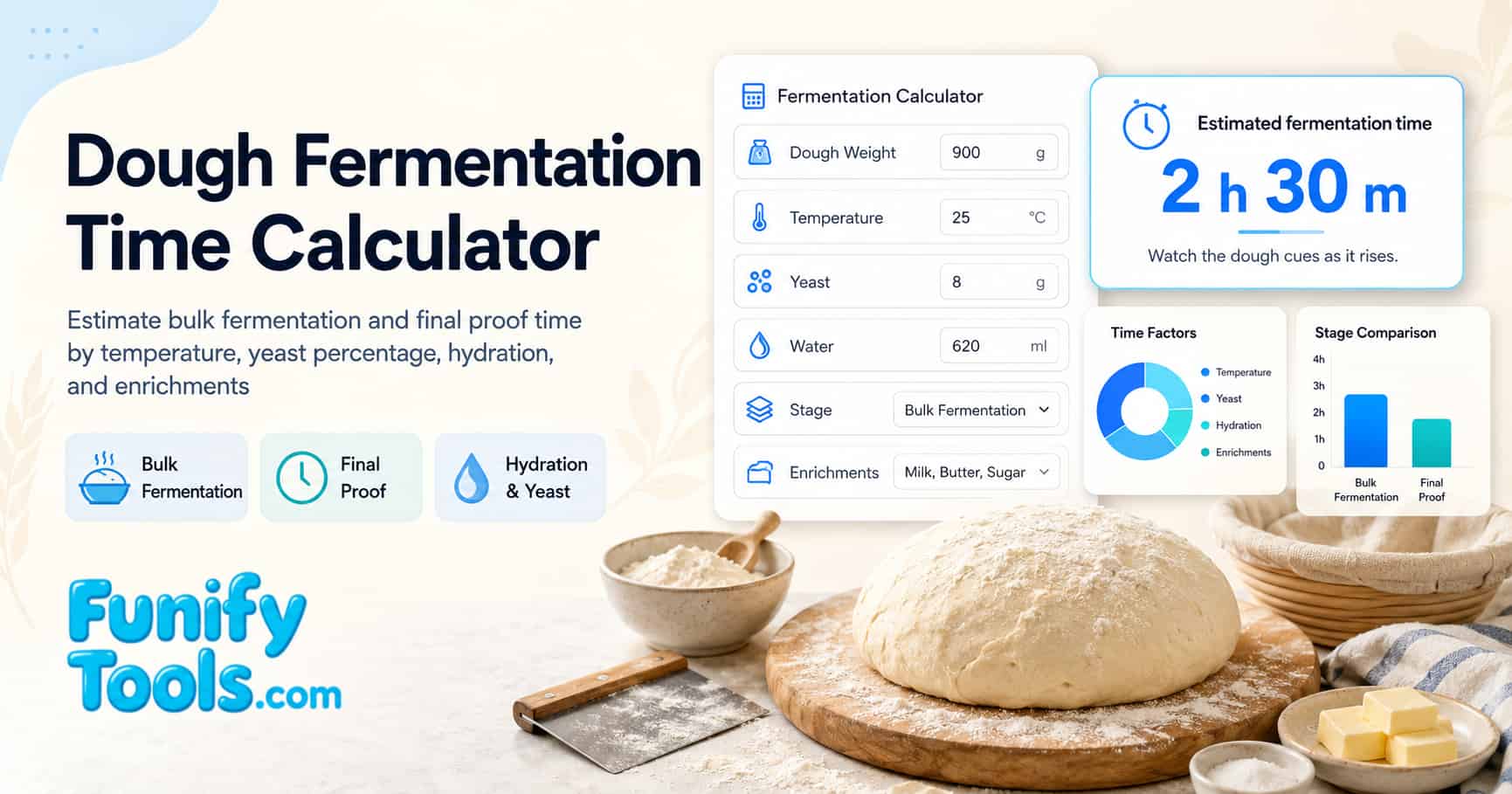
Lean dough at 25 °C, 1 percent yeast, and hydration near 65 percent often gives bulk around a couple of hours and proof around an hour. Add butter and time stretches. Add milk and time may shorten slightly.
Troubleshooting
If the estimate and the dough do not agree, trust the dough first and use the estimate to diagnose what changed. Fermentation problems usually come from temperature drift, inaccurate yeast measurement, flour differences, overmixing, undermixing, or dough that was warmer or cooler than expected after mixing.
- Too slow: raise dough temperature slightly or increase yeast percentage.
- Too fast: cool the dough or lower yeast, then tighten folds earlier.
- Weak structure: reduce hydration a little or give more rests.
Benchmarks
The ranges below are broad home-baking benchmarks, not strict rules. Flour type, mixer heat, dough size, container shape, and room conditions all matter. Use them to sanity-check the calculator result and then refine the timing with your own notes.
- Bulk: about 1.5 to 3 hours at the mid 20s °C with around 1 percent yeast.
- Final proof: about 1 to 2 hours under similar conditions.
- Enriched dough: expect longer timing, often close to double versus lean dough.
Recording runs
Track room and dough temperature, timing, and simple notes. Over a few bakes you will spot patterns and tighten your schedule. The calculator helps you start, and your notes help you finish well.
The fastest way to improve fermentation timing is to record what actually happened. Write down flour brand, dough weight, water amount, yeast grams, dough temperature after mixing, room temperature, bulk time, proof time, and the final result. A short note such as "slightly underproofed" or "excellent oven spring" is enough to make the next bake easier.
Over several bakes, your notes become more valuable than any generic recipe timing. You may learn that your kitchen runs cool in the morning, that your mixer warms dough quickly, or that a favorite flour needs more time to relax. Use the calculator for the first estimate, then let your baking log make each future estimate more personal and accurate.
Assumptions and limits
This calculator is designed for practical planning, not laboratory prediction. It models common fermentation influences in a simple way so home bakers can compare scenarios quickly. It does not know your flour's exact enzyme activity, dough pH, mixer friction factor, starter maturity, or the way your oven spring responds to shaping technique.
- Focus is on commercial yeast timing with simple factors.
- Hydration is based on total liquids divided by flour.
- Cold-retard timing extends beyond the warm estimate model.