Why ratios work
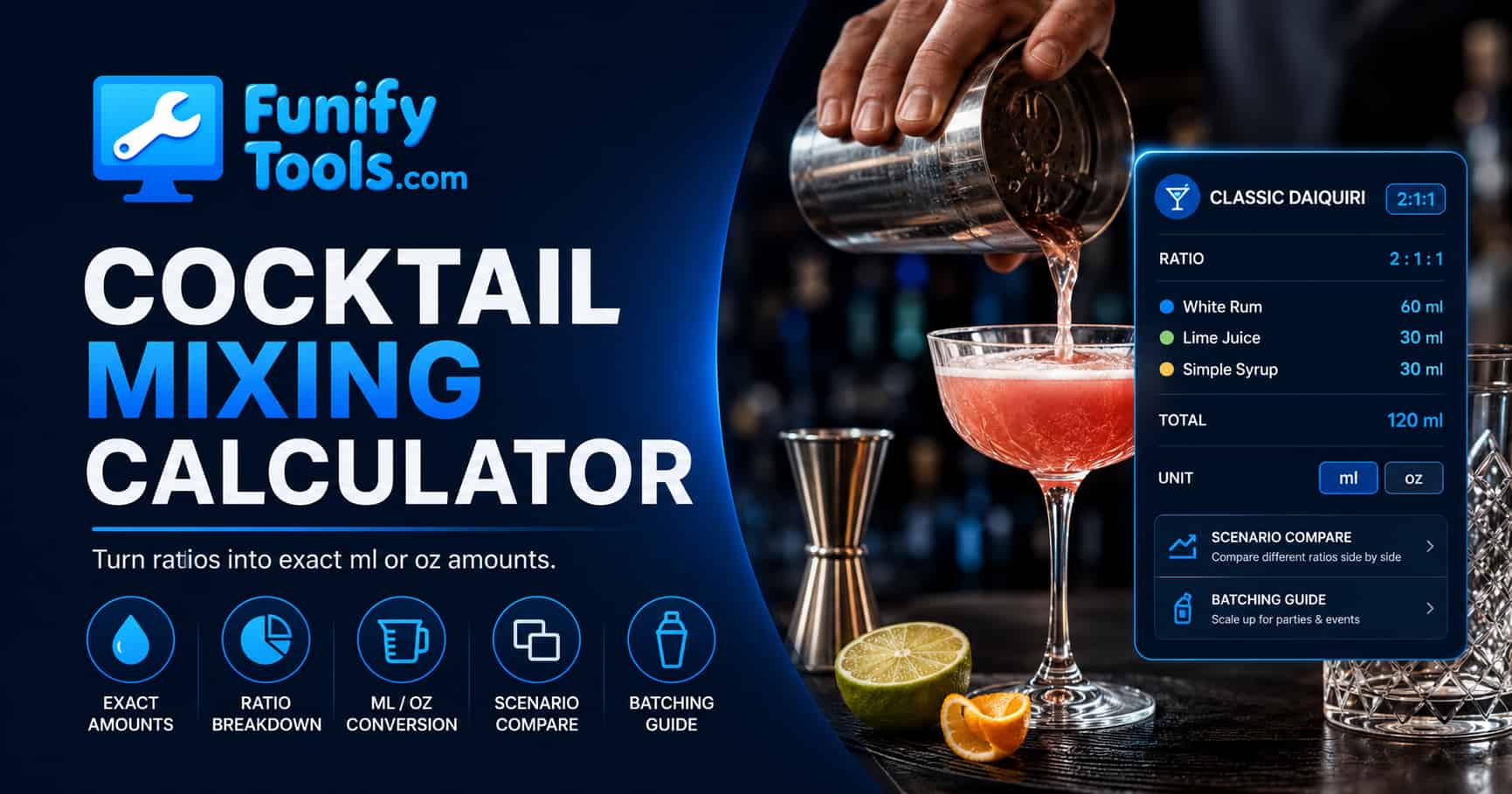
Ratios turn any cocktail recipe into a scale-free blueprint that works across different glass sizes and batch volumes. Instead of memorizing fixed ounce amounts, you remember a proportional structure like 2:1:1, meaning two parts spirit, one part sweet, and one part sour. Converting these parts into percentages allows you to scale precisely from a single serving to a large party batch using the cocktail mixing calculator. This ratio-based approach is a common foundation of professional bartending and helps keep each drink more consistent. For deeper reading, explore why cocktail ratios matter for consistency and how bartenders rely on proportional mixing.
Units and conversions
Bars in the United States commonly measure in fluid ounces, while many international recipes and professional references use milliliters. Understanding both systems is useful for any home bartender or professional mixologist. This calculator supports instant unit switching so you can work in whichever system matches your jigger or measuring tools. The standard conversion is 1 US fluid ounce equals approximately 29.57 milliliters. A typical single serving of a cocktail ranges from 90 ml (3 oz) to 180 ml (6 oz) before ice dilution and garnish. When scaling recipes, always confirm which ounce standard a recipe uses, because the US fluid ounce differs from the imperial fluid ounce used in the UK (28.41 ml). For more details, see this ml to oz cocktail conversion guide for bartenders.
- 1 US fl oz = 29.57 ml (used by many cocktail recipes in the United States)
- 1 imperial fl oz = 28.41 ml (occasionally found in older British recipes)
- Many US-style jiggers measure 1 oz (30 ml) on one side and 1.5 oz (45 ml) on the other
- A single serving commonly sits between 90 and 180 ml before service dilution and garnish
| Unit | Milliliters (ml) | Fluid Ounces (oz) | Common Use |
|---|---|---|---|
| 1 teaspoon | 5 ml | 0.17 oz | Small modifiers, syrups |
| 1 tablespoon | 15 ml | 0.51 oz | Syrups, citrus juice |
| 1 jigger (small) | 30 ml | 1 oz | Base spirit pour |
| 1 jigger (large) | 45 ml | 1.5 oz | Standard spirit pour |
| 1 cup | 240 ml | 8 oz | Batch mixing |
Dilution and ice
This calculator focuses on pre-dilution ingredient amounts, which means the liquid volume before ice interacts with the drink. In practice, dilution from melting ice is one of the most important variables in cocktail making. Shaken cocktails often gain 20% to 30% additional water volume from ice melt, which softens the alcohol burn and integrates flavors. Spirit-forward stirred cocktails like the Martini or Manhattan usually dilute less, often around 10% to 15%. If you need precise control over final alcohol strength or final volume, track your water addition separately. Using large, dense ice cubes slows dilution, while crushed ice accelerates it. For a complete understanding, learn about cocktail dilution and ice melt percentages to refine your technique.
Batching for events
When preparing cocktails for parties, weddings, or large gatherings, batching is the most efficient approach. Use the calculator to set the number of servings and a target per-serving amount, and it will compute the exact ingredient volume needed. The golden rule of batching is to prepare everything except carbonated components. Soda water, tonic, champagne, or ginger beer should be added at service time to preserve carbonation and freshness. Pre-dilute your batch with a calculated amount of water to account for the ice melt that would normally occur during shaking or stirring. A good starting point is adding 15% to 20% water by volume for stirred batches and 20% to 30% for shaken-style batches. Store batched cocktails in sealed bottles or growlers, label them clearly with the date and serving instructions, and refrigerate until service.
| Event Size | Servings | Per Serving (ml) | Ingredient Batch (ml) | Pre-dilution Water (ml) |
|---|---|---|---|---|
| Small gathering | 10 | 120 | 1,200 | 180–240 |
| Party | 25 | 120 | 3,000 | 450–600 |
| Wedding reception | 100 | 120 | 12,000 | 1,800–2,400 |
| Large event | 200 | 150 | 30,000 | 4,500–6,000 |
Acidity and sweetness balance
The foundation of countless classic cocktails is the balance between acid and sugar. The sour formula, typically 2:1:1 (spirit : sweet : sour), is a proven starting point for drinks like the Margarita, Daiquiri, and Sidecar. However, the ideal balance shifts depending on the specific spirits, liqueurs, and fresh citrus you use. Limes are usually more acidic than lemons, and some orange liqueurs are sweeter than others. Start with the classic ratio, then adjust in small 5% increments. Always taste after chilling because temperature strongly affects how we perceive sweetness and acidity. A drink that tastes balanced at room temperature may taste different once it is properly chilled and diluted. For advanced techniques, read this cocktail acid and sweetness balance guide for home and professional mixologists.
Worked examples
Understanding how ratios translate into actual measurements is the key to confident cocktail making. Here are two classic examples worked out step by step using this calculator.
| Cocktail | Ratio | Ingredient | Percentage | Amount at 120 ml | Amount at 200 ml |
|---|---|---|---|---|---|
| Margarita | 2:1:1 | Tequila | 50% | 60 ml | 100 ml |
| Triple sec | 25% | 30 ml | 50 ml | ||
| Lime juice | 25% | 30 ml | 50 ml | ||
| Tom Collins | 3:2:1:4 | Gin | 30% | 36 ml | 60 ml |
| Lemon juice | 20% | 24 ml | 40 ml | ||
| Simple syrup | 10% | 12 ml | 20 ml | ||
| Soda water | 40% | 48 ml | 80 ml |
Substitutions
Ingredient substitutions allow you to customize cocktails to your taste preferences, dietary needs, or available pantry items. Swap triple sec for a dry orange liqueur like Curaçao to reduce overall sweetness while adding complexity. Replace simple syrup with honey syrup (honey diluted with warm water at a 1:1 ratio) or agave nectar, but reduce the percentage by 5 to 10 points since these sweeteners are more intense than plain sugar syrup. Always use fresh citrus juice when possible, because bottled juice often lacks the bright acidity and aromatic oils that define a great cocktail. For spirit substitutions, consider that aged spirits like reposado tequila or aged rum bring vanilla and oak notes that can replace some of the sweetness from liqueurs. Herbal liqueurs like Chartreuse or Benedictine can add depth in place of simple syrup in certain recipes.
Portion strategy
Successful event planning starts with accurate portioning. Pick a per-serving target volume based on your glassware. Spirit-forward cocktails served in a rocks glass often sit around 90 to 120 ml (3 to 4 oz), while tall drinks served in a highball or Collins glass often sit around 150 to 180 ml (5 to 6 oz). Multiply by the number of guests to get your base batch volume, then add a 10% to 15% safety margin to account for spillage, second rounds, or tasting. Label every batch container clearly with the cocktail name, total volume, unit of measurement, date prepared, and a note about whether carbonated ingredients still need to be added at service. This systematic approach prevents confusion during busy service and makes each batch easier to reproduce.
Case study
A craft cocktail bar runs a blind taste test comparing two sour variations. Version A follows the classic 2:1:1 sour formula (spirit : sweet : sour). Version B uses a slightly drier 2:0.9:0.9 formula and adds a few drops of 20% saline solution to each serving. Over 50 guest tastings, Version B scores higher for perceived balance and flavor integration. The small saline adjustment helps reduce perceived bitterness and can enhance sweetness perception without adding more sugar. The key insight is that small ratio adjustments can produce noticeable differences, and using this calculator makes those adjustments precise and repeatable across batches. The bar now uses Version B as a house variation and has applied the same testing method to other sour-style cocktails on the menu.
Assumptions and what is not included
- The focus is ratio-based ingredient amounts before dilution, so ice melt is not factored into the calculated volumes.
- The unit switch converts values between ml and oz without changing the underlying ingredient ratios.
- Accuracy depends on careful measurement using calibrated jiggers or measuring tools and fresh, high-quality ingredients.
- Carbonation, ice melt volume, garnish displacement, glass size variation, and individual tasting adjustments are not automatically included in the calculation.
- Alcohol by volume (ABV) and final drink strength are not calculated, because this tool focuses on volume ratios only.
- Always taste and adjust before serving, as ingredient brands and freshness can affect flavor balance.
References
Wikipedia Cocktail | Wikipedia Mixed drink | Wikipedia Jigger | IBA John Collins | Liquor.com Tom Collins