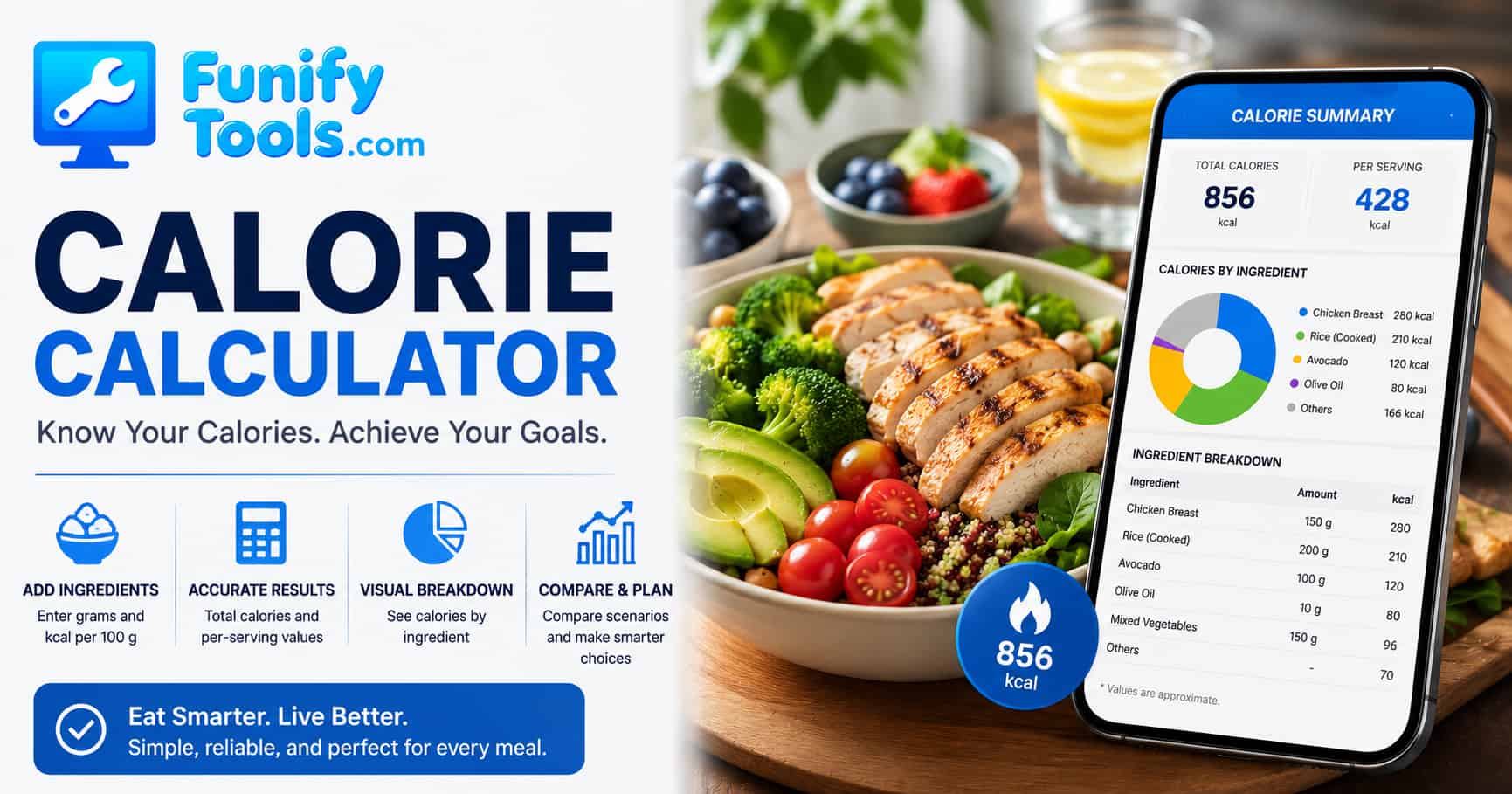
Why kcal per 100 g
Most nutrition labels publish energy as kilocalories per 100 grams (kcal per 100 g). This standardized format allows you to multiply the weight of each ingredient you use by the label value and divide by 100 to obtain the exact calorie contribution. The kcal per 100 g standard eliminates confusion caused by varying serving sizes, different package weights, and inconsistent portion definitions across brands and regions. Whether you are tracking calories for weight management, meal planning, or recipe development, understanding this calculation method is essential for accurate calorie counting in home cooking.
Label reading
Check the nutrition facts panel for energy listed per 100 g and per serving. Always prefer the per 100 g number for your calculations because the serving size listed on the package may differ from the amount you actually use. If the food is drained, cooked, or prepared in any way, confirm whether the printed values reflect the prepared product or the raw product. For mixed dishes such as frozen dinners or canned soups, enter each major component separately when possible for the most accurate total. For more tips on interpreting food labels, see how to read nutrition labels for calorie counting.
Accurate weighing
Place your digital kitchen scale on a stable, level surface and tare the container before adding each ingredient. Add ingredients gradually and read the display at eye level. For high-calorie ingredients such as oils, nut butters, cheese, and nuts, measure to the gram because even small weight differences can shift the total calorie count by 50 kcal or more. For liquids, weighing in grams is more reliable than using volume measurements like cups or tablespoons. Keep a notepad or use our Funify Notes feature to record values as you cook. Learn more about best kitchen scales for calorie tracking.
Cooking method adjustments
Cooking does not usually remove the energy from the food itself, but the calories in the portion you actually eat can change when oil is added, fat drips away, or cooking liquid is discarded. Frying and sautéing add fat calories from the oil or butter used in the pan. Grilling and broiling allow some fat to drip away, which can slightly reduce the calorie content of the meat you consume. Boiling, steaming, and poaching typically add no extra calories. When you add cooking oil, butter, or any fat, enter its exact grams as a separate ingredient in the calculator. If you discard marinade, brine, or cooking liquid, do not count those calories. For more details, refer to how cooking methods affect calories in food.
Density versus volume
The weight of a tablespoon varies dramatically between ingredients. One tablespoon of olive oil weighs about 14 g, while a tablespoon of chopped fresh herbs may weigh only 2 to 3 g. This means volume-based measurements introduce significant error into calorie calculations. If your recipe uses cups, tablespoons, or teaspoons, convert them to grams using a reliable density chart for each specific ingredient before entering values into the calculator. For common baking ingredients, see grams to cups conversion chart for cooking.
Common foods calorie reference table
The table below lists typical kcal per 100 g values for frequently used ingredients. Use these as a starting point and adjust based on your actual product label.
| Food category | Item | Typical kcal per 100 g |
|---|---|---|
| Grains | White rice (cooked) | 130 |
| Grains | Brown rice (cooked) | 111 |
| Grains | Pasta (cooked) | 131 |
| Grains | Oatmeal (cooked with water) | 71 |
| Grains | Quinoa (cooked) | 120 |
| Proteins | Chicken breast (grilled, skinless) | 165 |
| Proteins | Ground beef (80/20, cooked) | 254 |
| Proteins | Salmon (cooked) | 206 |
| Proteins | Egg (whole, cooked) | 155 |
| Proteins | Tofu (firm) | 76 |
| Vegetables | Broccoli (raw) | 34 |
| Vegetables | Spinach (raw) | 23 |
| Vegetables | Sweet potato (baked) | 90 |
| Fruits | Banana (raw) | 89 |
| Fruits | Avocado (raw) | 160 |
| Fruits | Apple (raw, with skin) | 52 |
| Dairy | Whole milk | 61 |
| Dairy | Greek yogurt (plain, nonfat) | 59 |
| Dairy | Cheddar cheese | 403 |
Cooking oil and fat calorie table
Oils and fats are the most calorie-dense ingredients in any recipe. Even a small amount can significantly change the total. Use this table to check the values of common cooking fats.
| Fat type | kcal per 100 g | Approx. kcal per tbsp (14 g) |
|---|---|---|
| Olive oil | 884 | 124 |
| Butter (salted) | 717 | 100 |
| Coconut oil | 862 | 121 |
| Canola oil | 884 | 124 |
| Sesame oil | 884 | 124 |
| Ghee (clarified butter) | 876 | 123 |
| Lard | 902 | 126 |
| Mayonnaise (full-fat) | 680 | 95 |
Smart substitution calorie comparison table
Making simple ingredient swaps can reduce calories without sacrificing flavor. The table below shows common substitutions and their calorie impact per serving.
| Original ingredient | Calories (per serving) | Substitution | Calories (per serving) | Approx. savings |
|---|---|---|---|---|
| Mayonnaise (30 g) | 204 | Greek yogurt (40 g) | 24 | ~180 kcal |
| Whole milk (200 ml) | 122 | Unsweetened almond milk (200 ml) | 34 | ~88 kcal |
| Cheddar cheese (50 g) | 202 | Reduced-fat cheddar (50 g) | 130 | ~72 kcal |
| White rice (200 g cooked) | 260 | Cauliflower rice (200 g) | 50 | ~210 kcal |
| Ground beef 80/20 (150 g) | 381 | Ground turkey 93/7 (150 g) | 232 | ~149 kcal |
| Sour cream (30 g) | 60 | Plain Greek yogurt (30 g) | 18 | ~42 kcal |
| Pasta (200 g cooked) | 262 | Zucchini noodles (200 g) | 34 | ~228 kcal |
| Butter (14 g / 1 tbsp) | 100 | Olive oil (7 g / 0.5 tbsp) | 62 | ~38 kcal |
Worked example
Consider a simple chicken rice bowl batch for 3 servings: 450 g cooked white rice at 130 kcal per 100 g contributes 585 kcal. Grilled chicken breast 360 g at 165 kcal per 100 g adds 594 kcal. Olive oil 30 g at 884 kcal per 100 g adds about 265 kcal. The total is about 1,444 kcal, which equals about 481 kcal per serving. If you add 150 g of avocado at 160 kcal per 100 g, the total rises to about 1,684 kcal, or about 561 kcal per serving. This example shows how ingredient amounts and high-calorie additions can noticeably change the final numbers, even when the recipe is divided into multiple servings.
Smart substitutions
Replace calorie-dense spreads such as mayonnaise with Greek yogurt to save significant calories without sacrificing creaminess. Bake or air-fry instead of pan-frying to reduce added oil. Choose lean cuts of meat such as chicken breast or turkey and trim visible fat before cooking. Bulk up meals with low-calorie vegetables such as leafy greens, broccoli, or zucchini to increase volume without adding many calories. Legumes such as lentils and chickpeas add fiber and protein with moderate calorie density. Track oils and fats precisely because they are the most calorie-concentrated ingredients in any recipe. When using packaged foods, always rely on the actual nutrition label for your specific brand and flavor variant rather than generic database values.
Portion strategy
Decide your per-serving calorie target before you start cooking. Build bowls and plates around a core of vegetables (aim for half the plate), add a palm-sized portion of protein, use fats thoughtfully, and check the per-serving result from the calculator. Adjust sauces, dressings, and toppings at the end to land closer to your target. Using the scenario comparison feature in this calculator allows you to test different portion sizes and ingredient combinations before you cook, helping you make informed decisions ahead of time.
Case study
Two sauce options for a wrap: mayonnaise 30 g at 680 kcal per 100 g gives 204 kcal. Greek yogurt 40 g at 59 kcal per 100 g gives only 24 kcal. The swap saves about 180 kcal total, or 60 kcal per serving for three servings. When combined with spice, lemon juice, and fresh herbs, the taste remains similar while the calorie profile improves dramatically. If you make the same swap three times in a week, this single substitution can save about 540 kcal, which is meaningful for anyone managing their energy balance.
Assumptions and what is not included
- The calculator focuses on energy (calories) only. Micronutrients, fiber, sugar, and fat composition are not included.
- The unit toggle converts display values between kilocalories (kcal) and kilojoules (kJ) only. It does not affect the underlying calculation.
- Accuracy depends entirely on your weighing method, the precision of your kitchen scale, and the label values you enter.
- The calculator does not account for cooking weight changes such as water evaporation, fat rendering, or moisture absorption.
- Results are for general reference only. Confirm important dietary decisions with official sources or a qualified nutrition professional.
References and further reading
USDA FoodData Central | Wikipedia: Calorie | Wikipedia: Food energy | Search: food calories per 100 g